Travel guide
Eleven days in Colombia: Medellin, Guatape and the Caribbean coast
Two internal flights, one 740-step rock, and the discovery that Cartagena at midday is a sauna with a wall around it.
By TripSake travel desk · Published · Updated · 14 min read
- Trip length
- 11 nights, February
- Group
- 5 people, two with functional Spanish
- Bases
- Medellin 4, Santa Marta and Tayrona 4, Cartagena 3
- Booked ahead
- Two internal flights, Tayrona entry, one Rosario day
- Daily walking
- 6 to 16 km
- Season
- February, dry, 24 to 33 degrees on the coast
The short answer
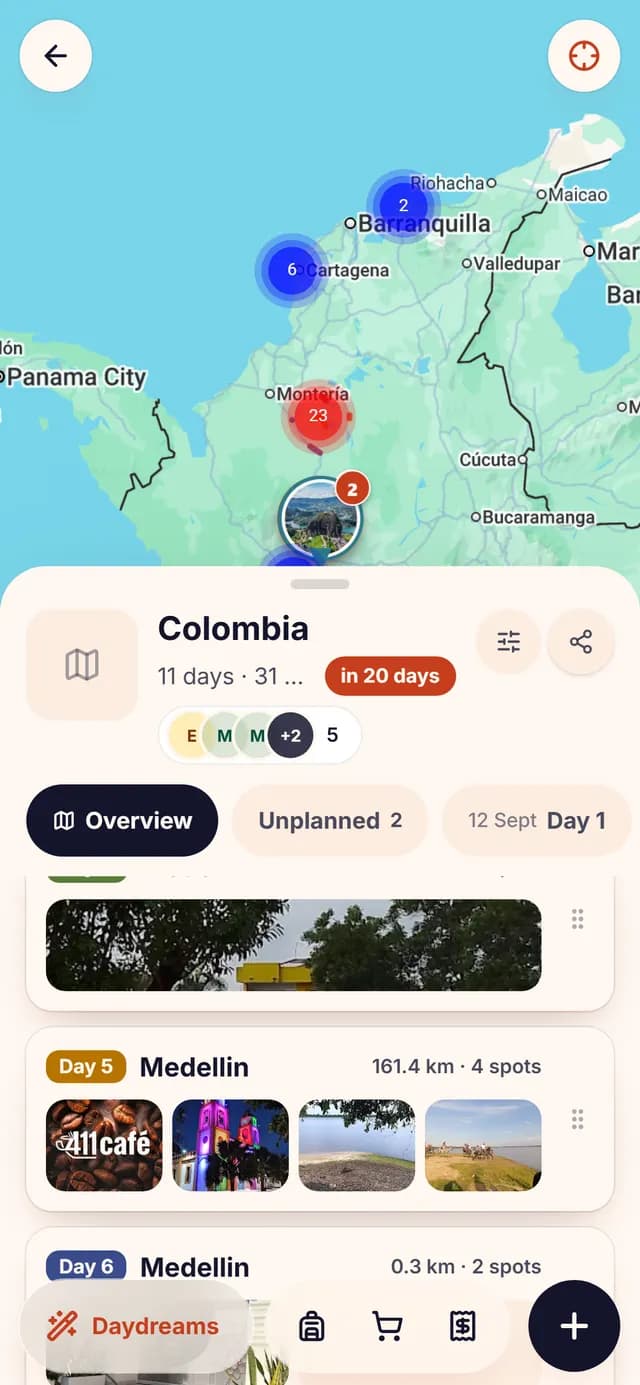
Eleven days works as four nights in Medellin, four on the Santa Marta side including Tayrona and Minca, and three in Cartagena. Fly between them, because the drive is fifteen hours. Do Comuna 13 with a guide from the neighbourhood, check the Tayrona closure calendar before booking anything, and treat Cartagena as an early-morning and evening city.
What to take away
- Fly. Medellin to the coast is an hour in the air and fifteen hours on the road.
- Comuna 13 with a guide who lives there. The history is the tour, not the escalators.
- Tayrona closes for several weeks a year. Check the dates before you book flights.
- Cartagena is unwalkable from noon to four. Plan around the heat, not through it.
- Guatape is a day trip from Medellin. Staying there costs you an evening in the city.
Medellin is a valley with a metro, and that explains it
Medellin sits in a narrow valley at 1,500 metres, which gives it the climate that earned it the nickname city of eternal spring, roughly 22 to 28 degrees all year. The city that spreads up the valley walls was, for decades, cut off from the one on the floor of it.
The metro and the cable cars that plug into it changed that, and they are the reason to spend a day riding public transport here. The Metrocable to Santo Domingo and on to Parque Arvi costs a normal fare plus a supplement, takes you over neighbourhoods that were unreachable a generation ago, and ends in a cloud forest above the city.
Stay in Laureles rather than El Poblado if you want the city rather than the expat version of it. Poblado is safe, comfortable and increasingly a strip of the same bars found in every digital-nomad district on earth. Laureles is where people live, is ten minutes away, and costs less.
- Metrocable to Arvi: an hour each way, and the best three euros in the city.
- Comuna 13 with a neighbourhood guide, in the morning.
- Laureles for a base, Poblado for one night out if you want it.
- Museo de Antioquia for the Botero collection, plus the square outside it.
Comuna 13, and how to visit it well
Comuna 13 was, in the early 2000s, the site of a military operation in a dense hillside neighbourhood, and the events of that period are within living memory of everyone who lives there. It is now on every itinerary, reached by outdoor escalators, covered in murals, and visited by several thousand people a day.
That can go two ways. A guide from outside the neighbourhood delivers a graffiti tour with a soundtrack. A guide who grew up there gives you the actual history, points at the specific stairs where specific things happened, and the money stays in the barrio. The second version is better and costs the same.
Go in the morning. By two in the afternoon the escalators are a queue, the viewpoints are full, and the sound systems are competing. Also: it is a residential neighbourhood. People are going to work up those stairs while you photograph them.
Guatape is a day, and the rock is the smaller half
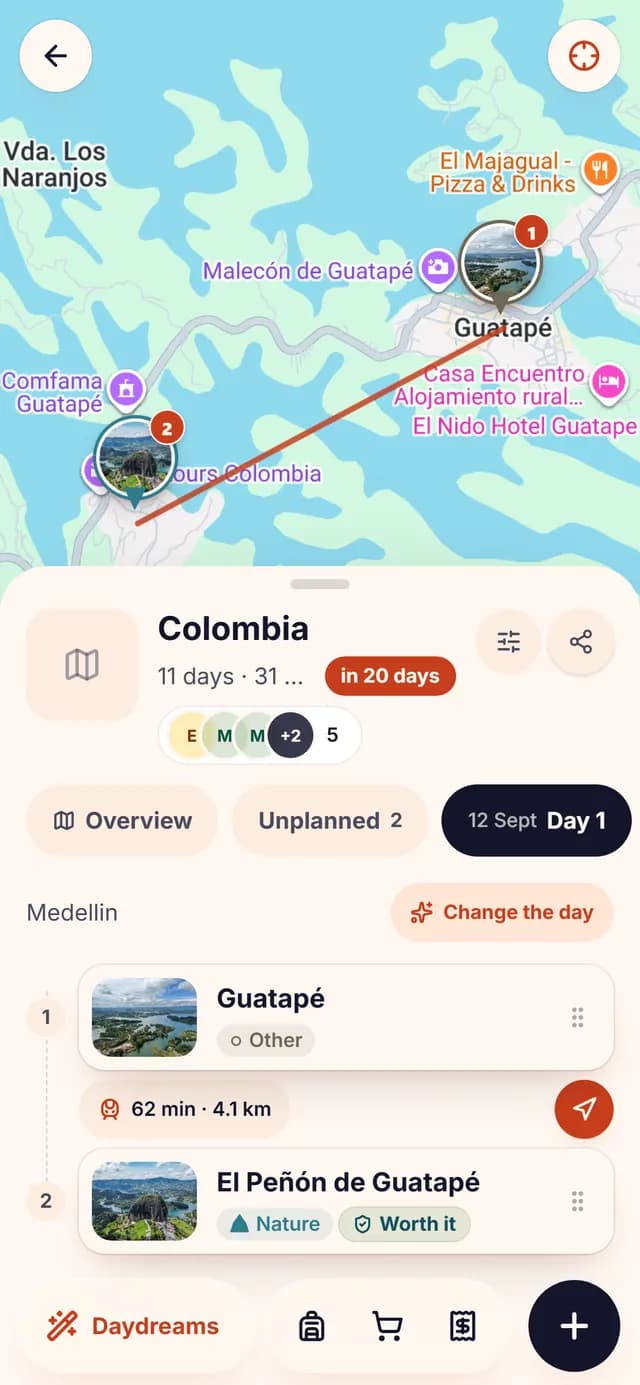
El Penol, the granite monolith with 740 steps zigzagging up a crack in its face, is the photograph. The climb takes twenty to thirty minutes, costs a small entry fee, and gives you a view over a flooded valley of islands and inlets that is genuinely unlike anywhere else.
The town of Guatape, ten minutes away, is the better half. Every building is painted with zocalos, moulded panels around the base of the wall showing what the household does or did. It is bright to the point of absurdity and it is a real town, not a film set.
This is a day trip. Two hours each way from Medellin by bus from Terminal Norte, or a private car for five people at roughly the same total cost with a much better schedule. Staying overnight in Guatape is pleasant and costs you an evening in a city with far more to do.
The coast: Santa Marta for the park, Cartagena for the city
Santa Marta itself is a scruffy port town and not the reason to go. It is the base for Tayrona, the national park where jungle meets Caribbean beaches, and for Minca, a village in the Sierra Nevada foothills at 600 metres where the temperature drops ten degrees and the coffee farms start.
Tayrona has closure periods, usually a few weeks spread across the year, when the park is handed back to the indigenous communities who own it. These dates are published and they move. Check them before you book flights, not after, because there is no workaround.
Inside the park, the walk from the Zaino entrance to Cabo San Juan takes about two hours in heat and humidity that surprises everyone, over roots and sand. Most beaches have dangerous currents and are marked as such; the swimming ones are La Piscina and Cabo. Do not underestimate the walk back in the afternoon sun, and do not do it in flip-flops, whatever anyone in your group claims.
Cartagena, the heat, and what eleven days cost
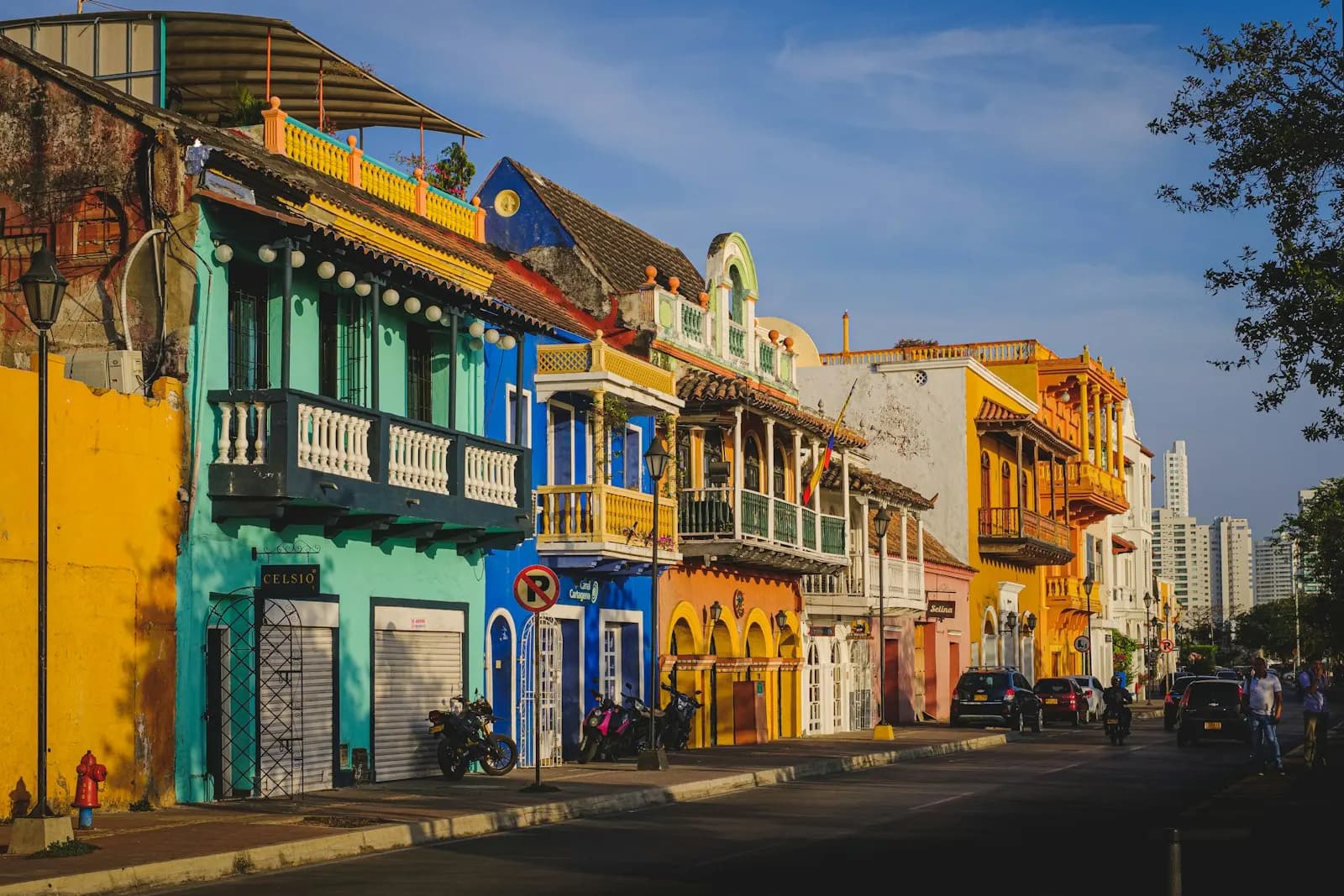
Cartagena's walled city is one of the best-preserved colonial centres in the Americas and it is at sea level on the Caribbean coast, which means from about eleven to four it is punishing. Plan mornings and evenings, and put the middle of the day in a hammock, a museum or a pool.
Getsemani, just outside the walls, is where we spent most evenings: street art, plaza life around Trinidad church, and the sense of a neighbourhood rather than a set. The walled city at seven in the evening, when the stone has stopped radiating heat, is a different and much better place than at noon.
Costs: internal flights were 40 to 80 euros a head booked six weeks out. A good dinner 60,000 to 90,000 pesos. Tayrona entry was around 70,000 for foreigners. A Rosario Islands day around 150,000 including the boat. Total for eleven days excluding international flights came to roughly 900 euros a head, and the flights and the Rosario day were half of it.
Day by day
Eleven days, three bases, two flights
Medellin first for the altitude and the temperate air, then the coast when everyone is acclimatised. The Tayrona day is fixed to the park calendar and everything else moves around it.
Days 1 to 2
Medellin
Laureles10 to 14 km a day
- 09:00
Comuna 13 with a local guideBooked
Walk · 3h 30m
Book a guide who lives in the neighbourhood. Morning, before the escalators become a queue.
- 14:00
Museo de Antioquia and Plaza Botero
Sight · 2h 30m
The Botero collection indoors and twenty-three of his bronzes in the square outside.
- 10:00
Metrocable to Parque Arvi
Travel · 4h
Metro fare plus a supplement. Over the hillside barrios into cloud forest, then walking trails at the top.
- 19:30
Dinner in Laureles
Food · 2h 30m
Where people live rather than where people land. Half the price of Poblado for better food.
Verdict. Four nights total. Two before Guatape and two after works better than four in a block.
Day 3
Guatape and El Penol
Day trip from Medellin7 km, plus 740 steps
- 07:30
Bus or private car to Guatape
Travel · 2h
Two hours each way. For five people a private car costs about the same as five bus tickets and leaves when you do.
- 10:00
El Penol de Guatape
Walk · 1h 30m
Small entry fee. 740 steps up a crack in a granite monolith, twenty to thirty minutes of climbing.
- 12:30
Guatape town and the zocalos
Walk · 2h 30m
Free. Painted panels on every building showing what each household does. A real town, not a film set.
- 15:30
Lunch on the waterfront
Food · 1h 30m
Trout from the reservoir, which is the local dish and is genuinely good.
Verdict. A day trip. Staying the night is pleasant and trades a Medellin evening for it.
Days 4 to 5
Back in Medellin, then fly north
Laureles, then Santa Marta9 km
- 10:00
Jardin Botanico and Parque Explora
Walk · 3h
Free garden, ticketed science museum with a good aquarium. A cooler day between two hot ones.
- 16:00
Pueblito Paisa at sunset
Sight · 1h 30m
A replica village on a hill in the middle of the city. Touristy, and the view over the valley at dusk earns it.
- 11:00
Flight Medellin to Santa MartaBooked
Travel · 1h 30m
40 to 80 euros booked six weeks out. The alternative is fifteen hours by road.
- 18:00
Taganga or the Santa Marta seafront
Food · 2h 30m
The town is scruffy and the sunsets are not. Ceviche and a beer on the malecon.
Days 6 to 7
Tayrona
Near the Zaino entrance, or inside the park14 to 16 km in humidity
- 07:00
Entry at El ZainoBooked
Travel · 1h
Around 70,000 pesos for foreigners. Check the annual closure weeks before booking anything else.
- 08:00
Walk to Cabo San Juan
Walk · 2h 30m
Two hours over roots and sand in high humidity. Proper shoes. Carry water; there is one shop at the far end.
- 11:00
La Piscina and Cabo San Juan
Open · 4h
The two beaches that are safe to swim at. Most of the others have currents and are signed accordingly.
- 16:00
Walk back, or stay in a hammock
Hotel · 3h
The afternoon walk out is hotter than the morning walk in. The hammocks at Cabo are basic, memorable and cheap.
Verdict. One long day is enough for most people. A night inside the park is the version worth doing if you can stand a hammock.
Day 8
Minca
Up in the Sierra Nevada foothills9 km
- 09:00
Moto-taxi or jeep up to Minca
Travel · 1h
Forty-five minutes up a rough road from Santa Marta. The moto-taxi is the local option and is exactly as advertised.
- 11:00
Coffee farm tour
Sight · 2h 30m
Small working fincas rather than plantations. The tour ends in a cup you will think about later.
- 15:00
Pozo Azul or Marinka falls
Walk · 3h
Freshwater swimming after four days of salt. Marinka charges a small fee, Pozo Azul is free and busier.
Verdict. The best decision of the coastal leg. Ten degrees cooler and an entirely different country.
Days 9 to 11
Cartagena
Getsemani8 to 12 km, all of it before noon or after five
- 08:00
Walled city, early
Walk · 3h
Free. Before nine it is cool enough to enjoy and quiet enough to hear. By eleven it is neither.
- 11:30
Castillo San Felipe
Sight · 2h
The fortress above the city, with tunnels. Go early; there is very little shade on the ramparts.
- 17:30
Getsemani and Plaza Trinidad
Evening · 4h
Street food, music and the neighbourhood out on the steps. This is where the evenings happen.
- 08:30
Rosario Islands dayBooked
Open · 8h
Around 150,000 pesos including the boat. Book a smaller operator; the big party boats are a different day out entirely.
Verdict. Three nights. The city is a morning and evening city and you need both of each.
Cartagena airport is fifteen minutes from the walled city, which makes the last morning easy. If you have three more days, the Lost City trek from Santa Marta is four days of jungle walking and is the trip people talk about for years afterwards. It does not fit into eleven days with everything else.
Honest comparison
Two flights, a park with closure weeks and five people
Colombia is not hard to travel. The planning problems are specific: internal flights that need booking early, a national park with published closure periods that move each year, and a heat schedule that makes half the day unusable on the coast.
None of the generic planners we tried had anything to say about the last two.
| What | Wanderlog, TripIt, Maps lists | TripSake |
|---|---|---|
| Flights as fixed points | A booking reference in one person's email and a line in a list. | Forward the confirmation and the flight sits in the trip with live status, anchoring its day, visible to everyone including the two who never check email. |
| A park that closes for weeks | Opening hours on a place page, which say nothing about a month-long closure. | The closure goes in as a note on the spot when you add it, so it is attached to the plan rather than buried in a chat from November. |
| Beaches and murals with no names | Search needs a name. "This place in Colombia is unreal" is not one. | Paste the clip and the place comes back pinned with photos and hours, and the four saves of the same Guatape street become one spot. |
| Planning around the heat | A plan that puts the fortress at one in the afternoon because that is where it fell in the list. | Stops are sequenced with real travel times and you can see the whole day at once, which is when it becomes obvious that noon in Cartagena is not a slot. |
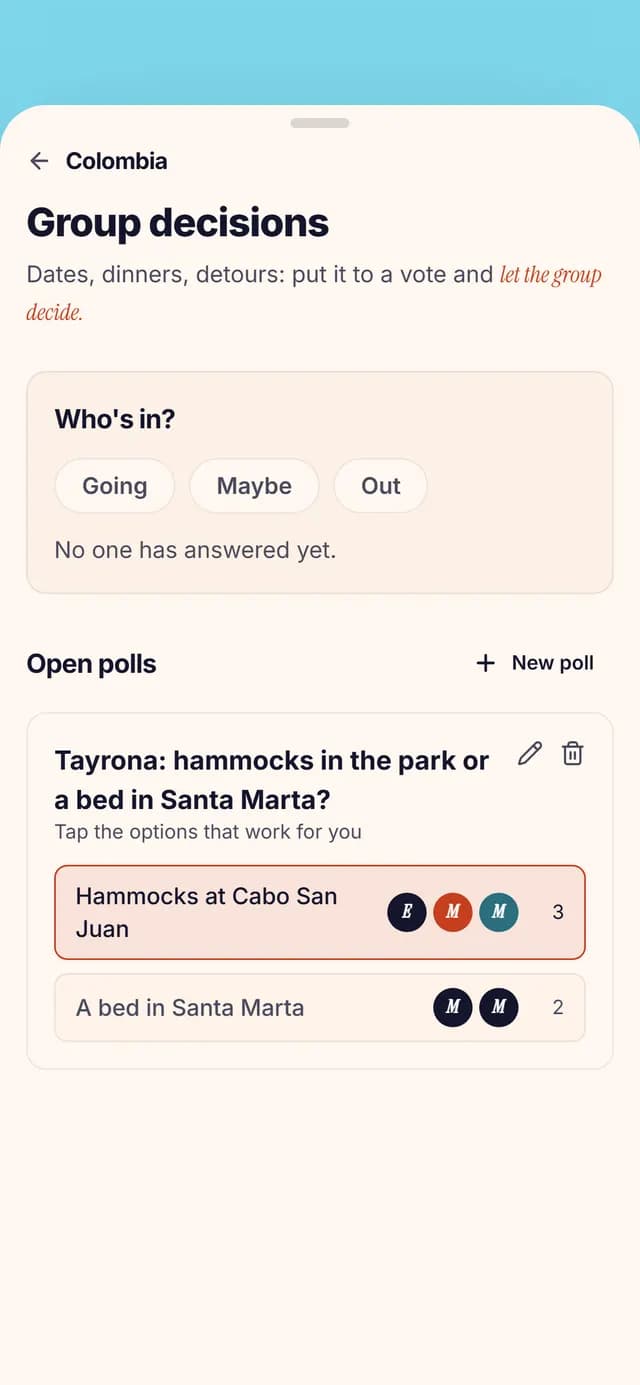
| Five people, no shared account | Everyone signs up or nobody sees the plan. | One invite link. Guests vote, add spots and read the plan. |
| Cash on the coast, cards in the city | A separate splitting app started somewhere around day six. | Expenses in the trip with receipt scanning, split as you go, settled once at the end. |
| What it costs | A subscription per person for a two-week trip. | Free, no premium tier, everyone on the same plan. |
The two things that would have cost us real money here were booking the internal flights late and booking around a Tayrona closure. Both are boring, both are avoidable, and both are the kind of thing a shared plan catches and a group chat does not.
Questions travellers ask
Before you book
How many days do you need in Colombia?
Eleven covers Medellin, Guatape and the Caribbean coast without rushing: four nights in Medellin, four around Santa Marta including Tayrona and Minca, three in Cartagena. Add four more for the Lost City trek, which does not fit otherwise.
Should I fly or take the bus from Medellin to the coast?
Fly. It is roughly an hour in the air against fifteen hours on the road, and internal flights booked six weeks out were 40 to 80 euros a head. The bus is a serious commitment for no gain.
When does Tayrona national park close?
For several weeks each year, usually split across a few periods, when the park is returned to the indigenous communities who own it. The dates are published in advance and change year to year, so check them before booking flights.
Is Comuna 13 worth visiting?
Yes, with a guide who grew up there and in the morning. The history is the tour; the escalators and murals are the setting. By early afternoon it is a queue, and it remains a residential neighbourhood where people are commuting up those stairs.
Is Cartagena too hot to walk around?
Between about eleven and four, effectively yes, in February. Plan the walled city and the fortress for early morning, put the middle of the day somewhere with shade or water, and take the evenings in Getsemani.
How do I plan a Colombia trip from saved reels?
Paste the links into a TripSake trip. Places shown or mentioned become pins with photos, ratings and hours, duplicates merge, and forwarded flight confirmations anchor the days they belong to.
About the author
The TripSake travel desk plans and walks the routes we publish. This one was five people in February, three domestic flights, and one member who insisted on walking to Cabo San Juan in flip-flops.
Keep reading