Travel guide
Ten days in Croatia: Split, Hvar and Dubrovnik without living on ferries
Two islands instead of five, one ferry booked in advance, and the discovery that Dubrovnik empties completely at 17:00.
By TripSake travel desk · Published · Updated · 13 min read
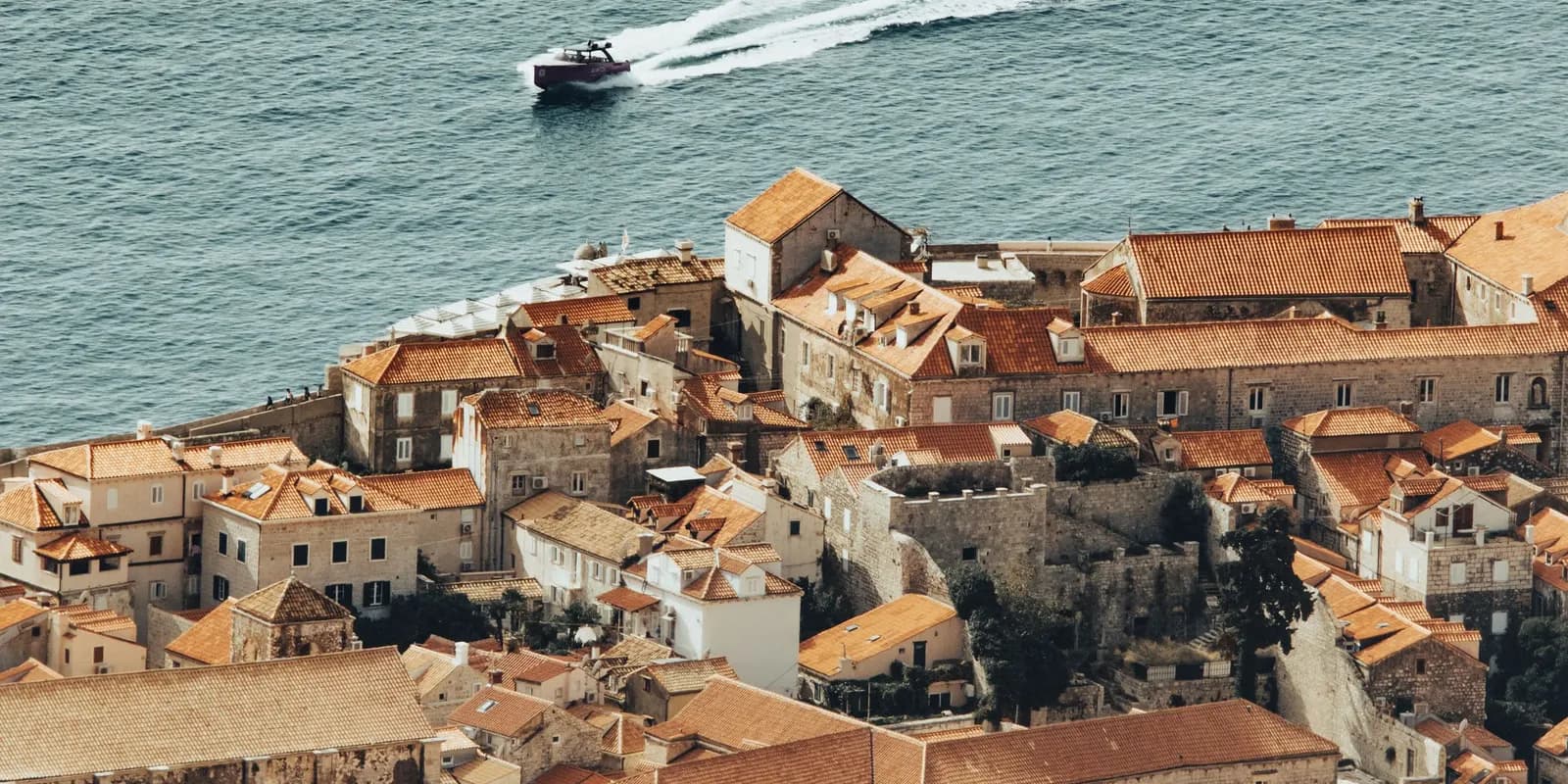
- Trip length
- 10 nights, late May
- Group
- 6 people, one who gets seasick
- Bases
- Split 3 nights, Hvar 4, Dubrovnik 3
- Booked ahead
- 3 catamarans, 1 boat tour, 2 dinners
- Daily walking
- 5 to 13 km, plus swimming
- Season
- Late May, 22 to 27 degrees, sea about 20
The short answer
Ten days on the Dalmatian coast is enough for three bases: Split, one island and Dubrovnik. Book the catamarans in advance in summer, stay two nights minimum per island, and check the Dubrovnik cruise ship schedule before deciding which morning you walk the walls. Adding a fourth island turns the trip into a ferry timetable.
What to take away
- Three bases in ten days. Every extra island costs you a full day in transit.
- Catamarans sell out in July and August. Car ferries usually do not, but they are slower.
- Hvar Town is one small corner of Hvar. The interior and Stari Grad are the reason to stay.
- Check which days cruise ships dock in Dubrovnik. It changes the city completely.
- The walls at 08:00 or at 18:00. Not at noon, in any month.
The island-hopping fantasy, and the timetable
Our first plan had five islands in ten days: Brac, Hvar, Vis, Korcula and Mljet. It looked like the best trip anyone had ever taken. Then we put the actual ferry times next to it and found that four of those days consisted of packing, a harbour, a two-hour crossing and finding a new flat.
Sailings between islands are far less frequent than sailings from the mainland. Getting from Vis to Korcula, which is about 60 kilometres, can involve going back to Split first. The map suggests a chain of stepping stones; the timetable is a wheel with Split at the middle.
Three bases in ten days gave us four full days on Hvar, which is what turned it from a stop into the part of the trip everyone remembers.
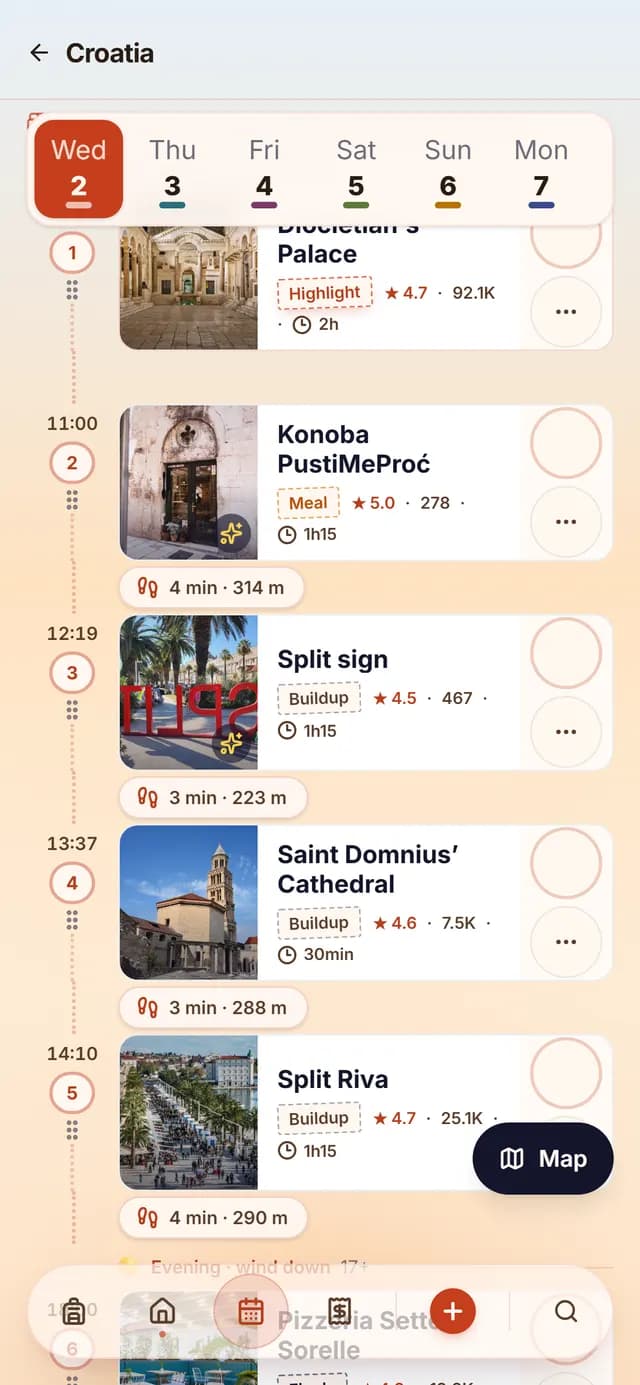
- Split, 3 nights. City, Diocletian's Palace, day trips.
- Hvar, 4 nights. Stari Grad or Jelsa, not only Hvar Town.
- Dubrovnik, 3 nights, with Korcula or Mljet as a day out.
- Everything else goes in the "next time" list, honestly.
Ferries: what to book and what to ignore
Two kinds of boat run this coast. Catamarans are passenger-only, fast, and sell out in July and August, sometimes days ahead. Car ferries are slower, take vehicles, and are much harder to fill, so they are the fallback when the catamaran is gone.
Book the catamarans as soon as your dates are fixed if you are travelling in summer. In May we booked three days out with no trouble, but the same route in August is a different problem. Jadrolinija and Krilo are the main operators, and the schedule changes with the season, which catches people who looked at a timetable in February.
One thing worth knowing: many crossings are not refundable and the sea state cancels them occasionally. If a ferry is the only thing between you and a flight home, do not schedule it for the morning of the flight. We put a night in Dubrovnik between the last island and the airport for exactly this reason, and the group thought I was being paranoid until a catamaran was cancelled the day we left.
Split is a Roman palace with a city inside it
Diocletian's Palace is not a ruin you visit. It is roughly half of the old town, with flats, bars, laundry and about three thousand residents inside walls that are seventeen hundred years old. You do not queue for it. You walk into it and then find you have been inside it for an hour.
The paid parts are the cellars, the cathedral and its bell tower. The tower is a narrow climb with open sides and it is the best view in the city for a couple of euros. The rest is free and open all the time, which means 08:00 is a completely different experience from 13:00.
Marjan hill is the thing most people skip. It is a pine-covered peninsula on the edge of the old town with swimming spots along the south side, and after two days of stone streets it is where the group went to lie under a tree and stop looking at things.
Hvar is not Hvar Town
Hvar Town is a small harbour with expensive bars, a fortress above it, and a reputation built on a nightlife scene that occupies about four streets. It is fine. It is also what a lot of people think the island is, and the island is 68 kilometres long.
We stayed in Stari Grad, which is the oldest town in Croatia, quiet, cheap by comparison, and twenty minutes from the ferry port. Between it and Hvar Town is the Stari Grad Plain, a UNESCO-listed grid of dry stone walls that Greek settlers laid out in the fourth century BC and which is still farmed in the same shape.
The east of the island is emptier again. Jelsa, Vrboska, and a coast road with turn-offs to bays that have four cars parked at them. Renting a car or two scooters for two of the four days is what made this leg work; the bus service exists but runs to a schedule built for residents.
Dubrovnik and the cruise ship problem
Dubrovnik gets up to several thousand cruise passengers on a docking day, and they arrive between roughly 09:00 and 10:00 and leave in the late afternoon. On a heavy day the Stradun is genuinely difficult to walk down. On a day with no ships in port, the same street at the same hour is pleasant.
The port publishes its schedule. Check it before you decide which morning you do the walls, and pick a light day if you have the choice. This is the single highest-value piece of planning on the whole trip and it takes about two minutes.
The walls cost around 35 euros, which is a lot, and are still worth it once. Go at opening or in the last two hours. There is no shade up there and the loop is two kilometres of steps in full sun. Also: the city empties out after about 17:00 when the ships leave, and the evening is when Dubrovnik is at its best.
What the trip actually cost us
Croatia is no longer the cheap option it was, and the coast in season is priced accordingly. A dinner in Hvar Town cost roughly double the same dinner in Stari Grad, and the Dubrovnik old town has a price band all of its own.
The things that saved money were unglamorous: eating lunch at a konoba away from a harbour, buying wine and produce at markets, and staying twenty minutes outside the two most photographed towns. The things that were worth paying for were the boat day and the walls.
Six people also means the money gets complicated fast, particularly with three currencies of habit: cash for the small konobas, cards in Split and Dubrovnik, and one person paying for the boat for everyone. We tracked it as we went, which is the only version of this that does not end in a spreadsheet on the flight home.
Day by day
Ten days on the Dalmatian coast
Three bases, three catamarans, and one day deliberately left blank on each island. The Dubrovnik days were ordered around the cruise ship schedule after we checked it.
Days 1 to 3
Split
Inside the old town, walking distance to everything9 to 12 km a day on foot
- 09:00
Diocletian's Palace, early
Walk · 2h
Free. The substructures and cathedral are ticketed, the streets are not. Before 10:00 it belongs to residents and delivery vans.
- 11:30
Cathedral bell tower
Sight · 45m
A few euros. Narrow, open-sided, and the best view over the roofs.
- 13:00
Lunch at a konoba off the Riva
Food · 1h 30m
Two streets inland from the waterfront the price drops by about a third.
- 15:30
Marjan hill and a swim
Walk · 3h
Free. Pine forest, a viewpoint and swimming spots on the south side. This is where locals go.
- 19:00
Riva and the Varos streets
Walk · 1h 30m
The waterfront at sunset, then the old fishermen's quarter behind it for dinner.
- 21:00
Dinner, Varos
Food · 2h
Booked once for six. Everywhere else we walked in.
Verdict. Three nights is right. Two would work if you drop one of the day trips.
Day 3 extra
Krka or Trogir from Split
Day trip, back the same evening7.4 km on foot
- 08:30
Bus or boat to Trogir
Travel · 1h
About an hour. Trogir is a small walled island town and takes half a day comfortably.
- 10:00
Trogir old town
Walk · 2h 30m
UNESCO listed, compact, and quieter than Split in the morning.
- 13:00
Lunch, Trogir
Food · 1h 30m
The seafront restaurants are aimed at day trippers. One street back is better and cheaper.
- 15:00
Swim at Okrug or back to Split
Open · 3h
The group split here. Krka waterfalls is the alternative version of this day and needs the full day, not half.
Days 4 to 7
Hvar, based in Stari Grad
Stari Grad, with a car for two of the days5 to 11 km a day
- 08:00
Catamaran Split to Stari GradBooked
Travel · 2h
Booked ahead. Roughly two hours. The car ferry takes longer and almost never sells out.
- 11:00
Stari Grad old town
Walk · 2h
Oldest town in Croatia. Stone lanes, a small harbour and a fraction of the prices in Hvar Town.
- 14:00
Stari Grad Plain
Walk · 2h
Free. A Greek field system from the fourth century BC that is still farmed in its original grid. Best on a bike.
- 10:00
Car day: the east and the north coast
Travel · 6h
Jelsa, Vrboska and the bays off the coast road. This is the day that justified the rental.
- 17:00
Hvar Town and the Fortica fortress
Sight · 3h
Go late. The fortress above town is a twenty minute climb and the sunset from it is the reason people come.
- 21:00
Dinner back in Stari Grad
Food · 2h
Around half of what dinner on the Hvar Town harbour costs, for better food.
Verdict. Four nights on one island was the best decision of the trip. Two would have been a stop rather than a stay.
Days 8 to 10
Dubrovnik
Outside the walls, in Ploce or Lapad8 to 12 km a day
- 09:30
Catamaran Hvar to DubrovnikBooked
Travel · 3h 30m
Long crossing, and the one our seasick member took a tablet for. Book it, and never on the day you fly.
- 08:00
City walls, on a light cruise dayBooked
Sight · 2h
About 35 euros. At opening or in the last two hours. No shade anywhere on the two kilometre loop.
- 11:00
Old town streets and Buza bar
Walk · 2h
The bar is a hole in the sea wall with a cliff to jump off. Drinks are overpriced and the setting is not.
- 15:00
Lokrum island
Sight · 4h
Ten minutes by boat. Peacocks, a monastery, a small salt lake and swimming, and it clears out the moment the last boat leaves.
- 18:00
The old town after the ships leave
Walk · 2h
Free, and the version of Dubrovnik worth seeing. The difference from noon is hard to overstate.
- 20:30
Dinner outside the walls
Food · 2h 30m
Ploce and Lapad are a fraction of the old town prices for the same food.
Verdict. Ordered around the cruise schedule. The walls on a light morning, the old town in the evenings.
Dubrovnik airport is about 30 minutes from the old town by shuttle bus, which runs to the flight schedule. Split airport is closer to Trogir than to Split. If you are flying out of one and in to the other, do it in that direction: Split to Dubrovnik follows the ferries, and the reverse fights them.
Honest comparison
Wanderlog, ferry timetables and six people in a chat
This trip had three planning problems at once: a ferry schedule that decides the shape of everything, six people with different ideas about how much boat time is acceptable, and about seventy saved videos of bays that nobody could name.
Standard planners handle the first badly, the second not at all, and the third not even slightly.
| What | Wanderlog, TripIt, Maps lists | TripSake |
|---|---|---|
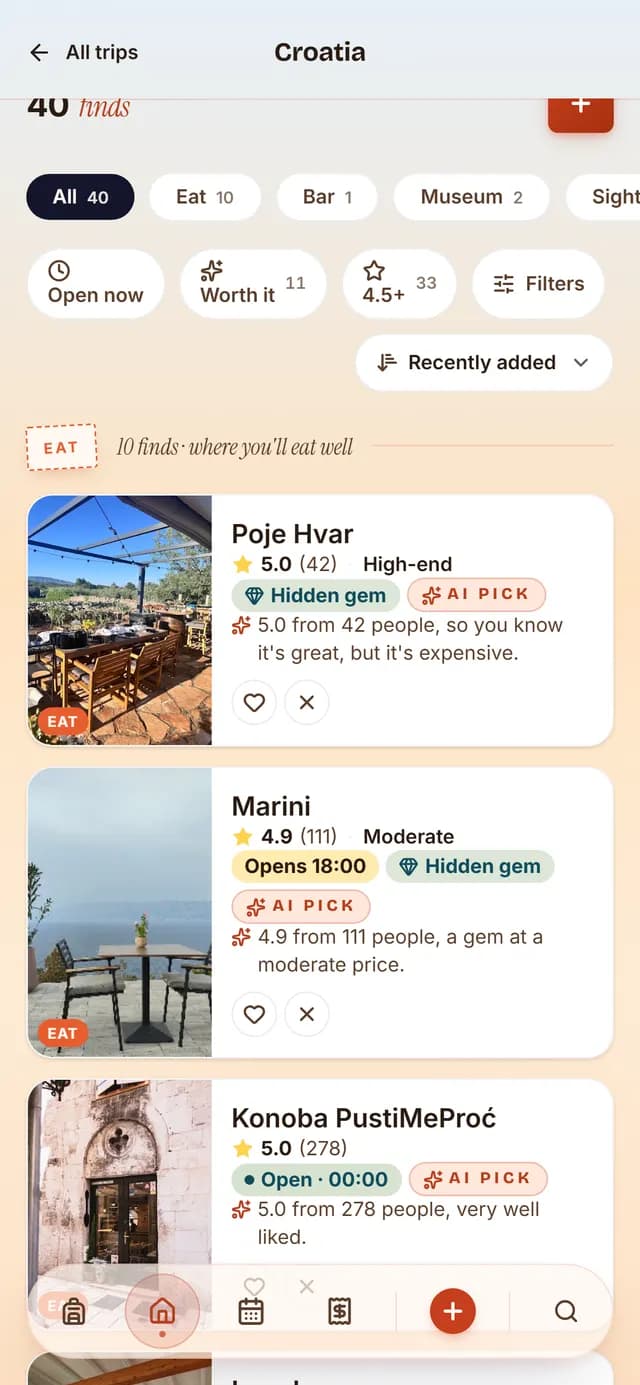
| Saved videos of unnamed bays | Wanderlog and Google Maps both need a place name typed into a search box. A drone shot of a cove with a caption saying "Croatia" is not a place name. | Paste the link and the places shown or mentioned are identified and pinned with photos, ratings and opening hours, with the clip kept attached. Our folder of 71 saves became 43 pins, several of which turned out to be the same beach. |
| Ferries as fixed points | A crossing is a line in a list. Nothing stops a plan putting a beach two hours from the port on a departure morning. | A booked crossing anchors the day and everything else is built around it, with real travel time rather than straight lines, and a flag when a stop would land while a place is shut. |
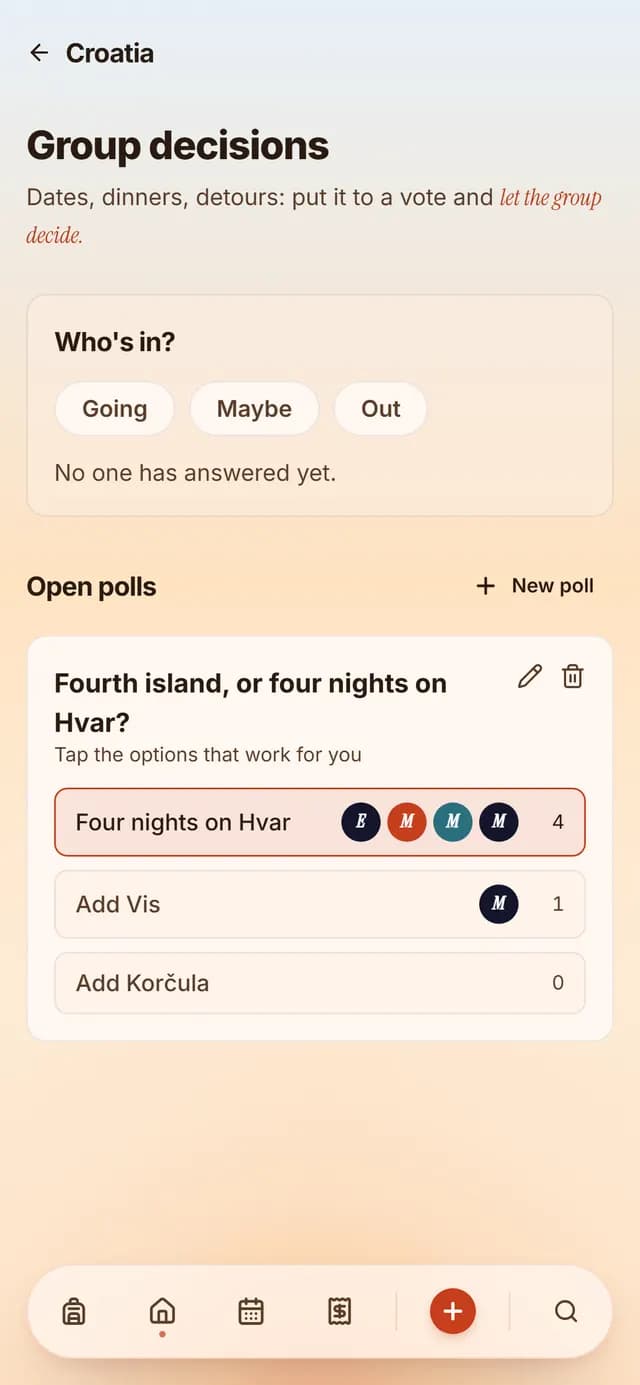
| Six people, one island argument | Shared editing. The most enthusiastic person adds five islands and everybody finds out on a harbour wall. | Yes or no per spot, plus polls. Ours was "Vis or four nights on Hvar", it took ten minutes, and Hvar won 4 to 2. |
| The one who will not install anything | Every collaborator needs an account, and in a group of six there are always two who never make one. | One invite link. Guests vote, add places and see the plan without signing up. |
| No signal on an island road | Offline access is a paid feature in most planners. | The plan, the spots and the map work offline at no cost, which on the Hvar coast road is not a luxury. |
| Six people, cash and cards | A separate splitting app, started on day four, with three cash payments already forgotten. | Expenses live in the trip with the same member list. Photograph the receipt, split it, settle once. |
| What it costs | Annual subscriptions, which in a group of six means one person paying and five on the free tier. | Free, no subscription, no premium tier, so everyone has the same app. |
Croatia is the trip where planning software earns its place, because the constraint is not taste, it is a timetable. Once the three crossings were fixed, the arguments left were about which bay to swim in, which is a much better argument to be having.
Questions travellers ask
Before you book
How many days do you need for Split, Hvar and Dubrovnik?
Ten is comfortable: three nights in Split, four on Hvar and three in Dubrovnik. Seven works with two bases. Adding a fourth island costs roughly a full day in transit each time.
Do I need to book Croatian ferries in advance?
In July and August, yes, for the fast catamarans, which sell out days ahead. Car ferries are slower and rarely full. In May and September a few days of notice was enough.
Should I stay in Hvar Town or Stari Grad?
Stari Grad if you want the island, Hvar Town if you want the bars. Stari Grad is quieter, cheaper, next to the main ferry port and twenty minutes from the Stari Grad Plain.
When is Dubrovnik least crowded?
Before 09:00 and after 17:00, and on days with no cruise ships docked. The port publishes its schedule, and checking it before you pick a morning for the walls is the highest-value two minutes of planning on the trip.
Are the Dubrovnik city walls worth the ticket?
Once, yes, at around 35 euros. Go at opening or in the final two hours. The loop is two kilometres of steps with no shade at any point.
How do I plan a Croatia trip from saved reels?
Paste the links into a TripSake trip. Places shown or mentioned in each clip become map pins with photos, ratings and opening hours, and the same bay saved by three people merges into one spot instead of three.
About the author
The TripSake travel desk plans and walks the routes we publish. This one was six people in late May, and the ferry schedule rewrote the itinerary twice before we left.
Keep reading