Travel guide
Kyoto and Osaka in eight days: one base, two cities, no bullet train roulette
Kyoto rewards early mornings and punishes ambitious afternoons. Osaka is the opposite. Here is the split that works.
By Mara Ellis, TripSake travel desk · Published · Updated · 12 min read
- Trip length
- 8 nights
- Group
- 4 people, two second-time visitors
- Bases
- Kyoto 5 nights, Osaka 3 nights
- Transport
- Local trains and buses, no rail pass
- Booked ahead
- 1 kaiseki dinner, 1 tea ceremony
- Season
- Mid November, peak autumn colour
The short answer
Eight days in Kansai works as five nights in Kyoto and three in Osaka, with Nara as a day trip. Kyoto temples want a 07:00 start and are unpleasant after 11:00. Osaka is an evening city and does not need early mornings at all. One move, two bases, no bullet train needed.
What to take away
- Fushimi Inari at 06:45 and Fushimi Inari at 13:00 are two different experiences at the same address.
- Kyoto is a morning city. Plan nothing important after 15:00 except dinner.
- Nara is a day trip, not an overnight. Ninety minutes each way and the deer are the least of it.
- Osaka does not need a plan before 16:00. That is the whole point of Osaka.
- Kyoto to Osaka is about 30 minutes on a local express. Do not buy a rail pass for this.
Kyoto is a morning city and the schedule has to admit it
Almost everything that makes Kyoto worth the flight happens before 09:00. Fushimi Inari at 06:45 is a quiet orange tunnel with maybe fifteen other people in it. At 13:00 the same path is a queue moving at shuffling pace with a photo happening every four metres. Arashiyama bamboo grove is the same story with a shorter window: by 09:00 it is over.
This is inconvenient in a way most itineraries pretend it is not. It means the useful day runs roughly 06:30 to 12:00, then there is a long, hot, crowded middle, then it becomes pleasant again around 16:30. Four days of that is a real physical demand and you should build in one late start.
We ran three genuinely early mornings out of five in Kyoto, with the fourth day starting at 10:00 on purpose. That ratio held up. Five early mornings in a row would not have.
- Fushimi Inari: 06:30 to 08:00. It never closes and there is no ticket.
- Arashiyama bamboo: before 08:30 or not at all.
- Kiyomizu-dera: opens 06:00. Almost nobody knows this.
- Ginkaku-ji and the Philosopher's Path: fine mid-morning, better at 08:30.
Where to stay in Kyoto, and the bus problem
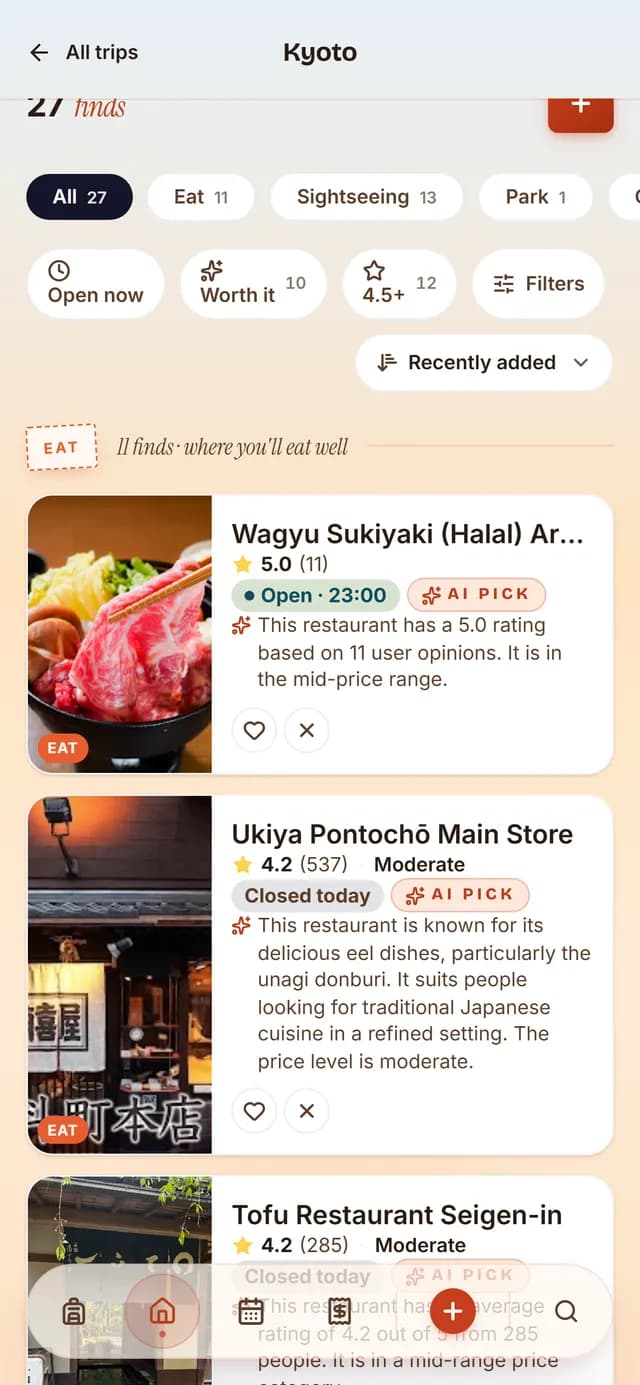
Kyoto has two subway lines and about forty places you want to go, which means buses. The buses are frequent, cheap and, in autumn, completely full. The 100 and 206 routes towards Kiyomizu-dera in November are standing room from the first stop.
So stay somewhere with a train option. We were near Karasuma Oike, which is on both subway lines and a fifteen minute walk from the Nishiki market. Anywhere along Karasuma or near Kyoto Station works. Gion is atmospheric and expensive and puts you on the wrong side for the north-west temples.
Get an ICOCA card at the airport or any station, tap on and off, and stop thinking about it. A Japan Rail Pass is a waste for a Kansai-only trip; the local Kyoto to Osaka trains are not JR-dependent and cost a few hundred yen.
The one temple decision that matters
There are more than 1,600 Buddhist temples in Kyoto and you will see maybe eight. After the fourth one, a certain sameness sets in, and by the sixth most groups have somebody quietly checking how long until lunch. This is not a failure of appreciation, it is a normal response to volume.
So pick for variety rather than for fame. Fushimi Inari is a shrine and a hill walk. Ryoan-ji is a rock garden and about twenty minutes. Sanjusangendo is a single long hall with 1,001 statues and nothing else, and it is the one everybody in our group brought up afterwards. Tofuku-ji in November is a valley of maples viewed from a bridge.
And leave Kinkaku-ji off unless someone insists. The golden pavilion is beautiful, it is also a single fixed viewpoint with a one-way path and a coach park, and the visit is about twenty-five minutes of which fifteen are queueing to stand in the right spot.
Nara is a day, not a night
Nara is about 45 minutes from Kyoto on the Kintetsu limited express and roughly an hour on the local. The deer in the park are the headline and are genuinely everywhere, and they bow for crackers, and after fifteen minutes that is the whole story.
What is worth the trip is Todai-ji, which contains a bronze Buddha about 15 metres tall in what was for centuries the largest wooden building on earth. It is one of the few things in Japan that is impressive in a purely scalar way. Then Kasuga Taisha with its three thousand stone lanterns on the walk up, and Nigatsu-do above it for the view back over the plain, which is free and where nobody goes.
Get the 07:40 train and you will be at Todai-ji before the coaches. Come back to Kyoto by 17:00 and you still have your evening. An overnight in Nara means paying for a hotel in a town that closes at 20:00.
Osaka does not need a plan
After five days of 06:30 alarms, Osaka is a relief. It is a food and evening city and it does not really start until the afternoon. We had almost nothing scheduled there and it was the right call.
Dotonbori is the neon canal everyone has seen and it is worth one evening walk, though the actual eating is better one street back in Hozenji Yokocho or over in Shinsekai. Kuromon market is a lunch, not a destination. Osaka Castle is a concrete reconstruction with a lift inside and the park around it is better than the building.
The thing we did not expect to like was the Umeda Sky Building. A 1993 office tower with a floating open-air observatory connected by an escalator through mid-air. About 1,500 yen, and it is the strangest and best view in Kansai.
What went wrong, and the day we rebuilt
Day four was supposed to be Arashiyama in the morning and Kinkaku-ji in the afternoon, which meant crossing the north-west of Kyoto twice on buses in peak autumn. We got to Arashiyama at 08:10, which was correct, and then spent 55 minutes at a bus stop, which was not.
We rebuilt the afternoon from the bus stop. The plan dropped Kinkaku-ji, kept us in the north-west, and added Ryoan-ji and Ninna-ji, which are both a short walk from each other and from where we already were. Everyone saw the new version at once and nobody had to be persuaded.
The general lesson: in Kyoto in November, treat every bus leg as twice as long as the timetable says. If a day requires more than two bus journeys, it is the wrong day.
Day by day
Eight days across Kyoto, Nara and Osaka
Five nights in Kyoto, three in Osaka, one move. The early starts are real and are the reason the temple days work. Times are as the plan built them.
Day 1
Arrival, central Kyoto
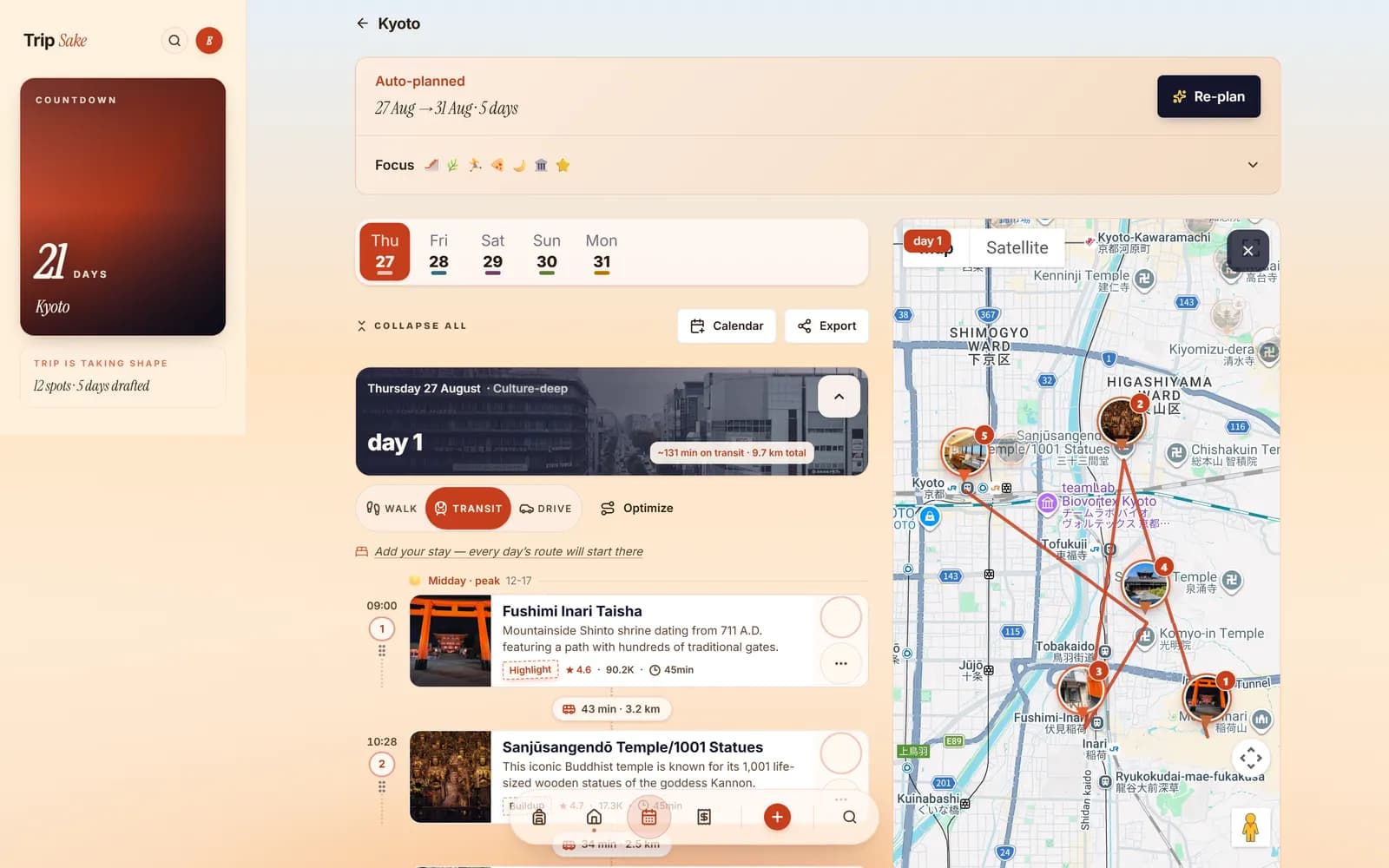
Karasuma and Nishiki5.4 km on foot
- 15:00
Check in, Karasuma Oike
Hotel · 30m
On both subway lines, which is the single most useful thing about a Kyoto hotel.
- 16:30
Nishiki Market
Food · 1h 15m
Closes around 18:00, so this is a late-afternoon stop, not an evening one.
- 18:00
Pontocho alley
Walk · 45m
A single narrow lane along the river. Walk it at dusk when the lanterns come on.
- 19:30
First dinner, Kiyamachi
Food · 2h
Booked. Nobody negotiates well after a long-haul flight.
Day 2
Fushimi Inari at dawn, southern Kyoto
South, on the JR Nara line11.8 km on foot
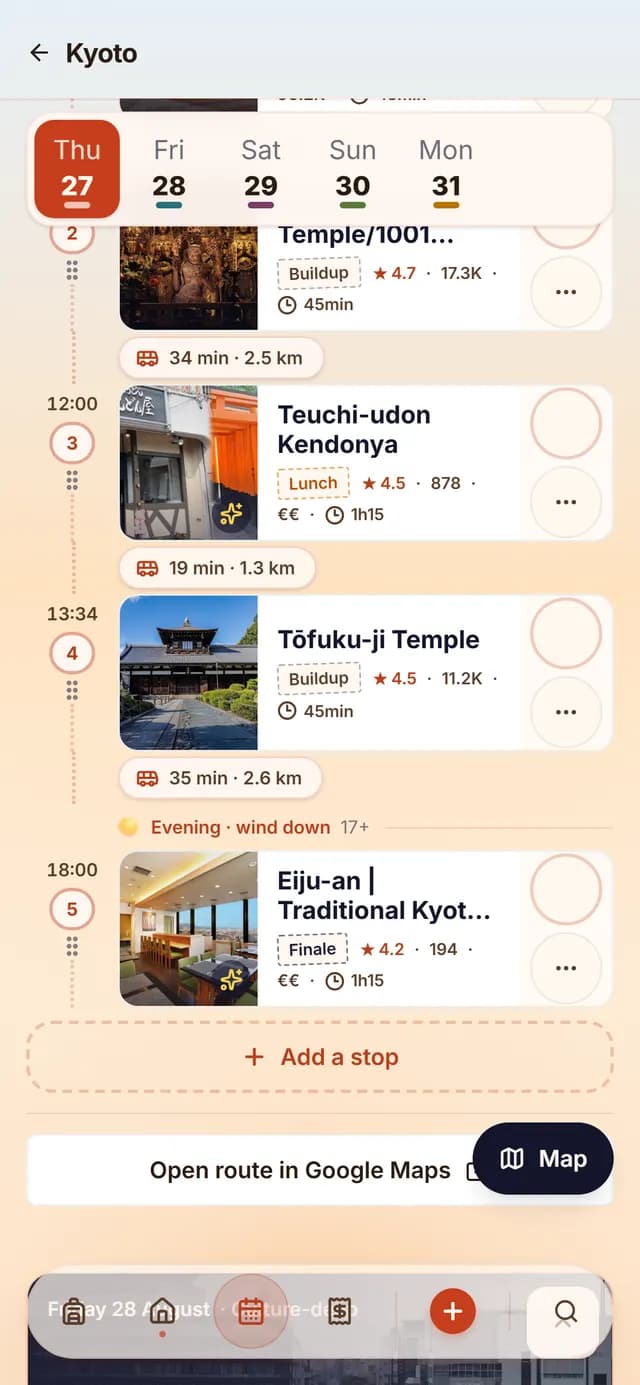
- 06:45
Fushimi Inari Taisha
Sight · 2h 15m
Free, never closes. Walk past the first dense torii section, up to Yotsutsuji, which is where most people turn around and where it gets good.
- 09:30
Breakfast near Inari station
Food · 45m
You will have walked four kilometres uphill before most people are awake.
- 10:45
Tofuku-ji
Sight · 1h 30m
About 1,000 yen for the bridge and garden in autumn. In mid November the maple valley is the best colour in the city.
- 13:00
Sanjusangendo
Sight · 1h
Around 600 yen. One 120 metre hall, 1,001 gilded statues, no photography. The most memorable interior in Kyoto.
- 14:30
Lunch, Shichijo
Food · 1h 15m
Between the temple and Kyoto Station, and priced for commuters.
- 17:00
Kyoto Station rooftop
Sight · 45m
Free. A brutalist glass canyon with an escalator to the roof. Divisive and worth twenty minutes.
- 19:00
Dinner, Kyoto Station food floors
Food · 1h 30m
Ramen Koji on the tenth floor. Eight regional ramen shops in one corridor.
Verdict. The 06:15 alarm was the best decision of the trip and nobody agreed with that at 06:15.
Day 3
Higashiyama, early
The eastern hills, walking north to south12.3 km on foot
- 06:30
Kiyomizu-dera
Sight · 1h 30m
Opens at 06:00, around 500 yen. At this hour the wooden stage has maybe twenty people on it. By 10:00 the approach road is impassable.
- 08:15
Sannenzaka and Ninenzaka
Walk · 1h
The preserved stone lanes below the temple. Shops open at 09:00 so before that it is empty and photographable.
- 09:45
Kodai-ji and the bamboo path
Sight · 1h
About 600 yen. A small bamboo grove with none of the Arashiyama crowd.
- 11:15
Yasaka Shrine and Maruyama Park
Sight · 1h
Free. The park is the natural break point and there are benches, which by now matters.
- 13:00
Lunch, Gion
Food · 1h 30m
Lunch in Gion is a third of the price of dinner in Gion for the same kitchen.
- 15:00
Tea ceremony, GionBooked
Sight · 1h 15m
Booked ahead, around 3,000 yen. Small group, actual explanation, not a costume photo shoot.
- 17:00
Shirakawa canal
Walk · 45m
The prettier and quieter half of Gion. Willows, a canal, and far fewer people photographing strangers in kimono.
- 19:30
Kaiseki dinnerBooked
Food · 2h 30m
The one expensive meal of the trip, booked six weeks out. Around 12,000 yen a head and worth doing once.
Day 4
Arashiyama and the north-west (rebuilt at a bus stop)
North-west Kyoto9.6 km on foot
- 08:10
Arashiyama bamboo grove
Walk · 45m
Free. By 09:00 it is a single-file crowd. It is also, honestly, about ten minutes of bamboo.
- 09:00
Tenryu-ji garden
Sight · 1h
Around 500 yen for the garden. The bamboo exit gate is at the back, so do this second and walk out into the grove.
- 10:15
Okochi Sanso villa
Sight · 1h
About 1,000 yen including matcha. A film actor's garden above the grove, and almost empty because of the price.
- 12:00
Lunch, Arashiyama
Food · 1h 15m
Cross the Togetsukyo bridge to the south side for half the price.
- 14:30
Ryoan-ji
Sight · 45m
Around 600 yen. Fifteen rocks in gravel. You will either be moved or you will be done in twenty minutes, and both are fine.
- 15:45
Ninna-ji
Sight · 1h 15m
A ten minute walk from Ryoan-ji, which is why it replaced Kinkaku-ji. Large, calm, and hardly anyone there.
- 19:00
Dinner, Nishiki area
Food · 2h
Back in the centre. Walk-in.
Verdict. Kinkaku-ji got dropped in favour of two temples we could walk to. Correct call.
Day 5
Nara day trip
Nara Park, back to Kyoto for the evening10.7 km on foot
- 07:40
Train to Nara
Travel · 45m
Kintetsu limited express, about 45 minutes. Ordinary express takes an hour and costs less.
- 08:45
Todai-ji
Sight · 1h 30m
Around 800 yen. A 15 metre bronze Buddha in an enormous wooden hall. Get there before the coaches at 10:00.
- 10:30
Nigatsu-do
Sight · 45m
Free, five minutes uphill behind Todai-ji, with a wooden veranda looking back over the plain. Almost nobody walks up.
- 11:30
Kasuga Taisha and the lantern path
Sight · 1h 15m
Free to walk, a few hundred yen for the inner area. Three thousand stone lanterns under cedar.
- 13:15
Lunch, Naramachi
Food · 1h 30m
The old merchant quarter south of the park, and the part of Nara with no deer in it.
- 15:30
Isuien Garden
Sight · 1h
About 1,200 yen. A borrowed-landscape garden that uses Todai-ji's roof as part of the composition.
- 17:30
Train back to Kyoto
Travel · 1h
Home by 18:30 with the evening intact, which is why this is a day trip.
Day 6
Late start, then move to Osaka
Kyoto morning, Osaka evening6.9 km on foot
- 10:30
Philosopher's Path
Walk · 1h 30m
Free. Two kilometres of canal under cherry trees, which in November are bare and the path is empty and better for it.
- 12:00
Ginkaku-ji
Sight · 1h
Around 500 yen. The silver pavilion, which is not silver. The moss garden and the sand cone are the reason.
- 13:30
Lunch, Okazaki
Food · 1h 30m
Near the Heian Shrine torii, quieter than anywhere in Higashiyama.
- 16:00
Train to Osaka
Travel · 30m
About 30 minutes on a Hankyu or Keihan limited express, a few hundred yen. No rail pass needed.
- 17:00
Check in, Namba
Hotel · 30m
Namba or Shinsaibashi. Osaka is an evening city and this is where the evening is.
- 19:00
Dotonbori and Hozenji Yokocho
Evening · 3h
The canal for the neon, the stone alley one street back for the actual food.
Verdict. The deliberate late day. After four early mornings it was not optional.
Day 7
Osaka, slowly
Umeda and the centre8.4 km on foot
- 11:00
Kuromon Ichiba market
Food · 1h 30m
Lunch rather than a sight. Grilled scallops and skewers eaten standing up.
- 13:30
Osaka Castle park
Walk · 1h 30m
The park and moat are free and better than the reconstructed interior, which has a lift in it.
- 16:00
Shinsekai and Tsutenkaku
Walk · 1h 30m
A 1950s vision of the future that never got renovated. Kushikatsu here, and do not double dip the sauce.
- 18:30
Umeda Sky Building
Sight · 1h 30m
About 1,500 yen. An open-air observatory floating between two towers, reached by an escalator through mid-air. The best view in Kansai.
- 21:00
Dinner, Umeda backstreets
Food · 2h
The lanes under the tracks near Osaka Station. Loud, cheap, excellent.
Day 8
Last day, nothing booked
Wherever the group votes7.2 km on foot
- 10:00
Nakazakicho
Coffee · 2h
A pocket of pre-war wooden houses turned into cafes, ten minutes from Umeda and unknown to almost every visitor.
- 12:30
Last okonomiyaki
Food · 1h 30m
It is the Osaka dish and it is worth eating twice.
- 14:30
Shopping, Shinsaibashi
Walk · 2h
A 600 metre covered arcade. Useful when it rains, which it did.
- 17:30
Airport
Travel · 1h
Nankai Rapi:t from Namba to Kansai airport, about 40 minutes. Book a seat if you have luggage.
Kansai airport is on an artificial island and the train is the only sensible way there. From Namba the Nankai line takes about 40 minutes; from Kyoto the JR Haruka takes about 80. If you are flying out of Kyoto, allow for the fact that the Haruka runs every 30 minutes and not more often.
Honest comparison
Why a Japan trip breaks most planners
Japan is where trip planning tools show their limits, because the two things that decide your day here are opening hours and travel time, and most planners treat both as decoration.
| What | Wanderlog, TripIt, Maps lists | TripSake |
|---|---|---|
| Opening hours | Wanderlog stores hours if the place has them. It will still happily let you build a day that arrives at a temple 25 minutes after it closes, because the itinerary is a list you ordered by hand. | The plan validates against opening hours as it builds. A stop that would land outside the window gets moved or flagged. In Kyoto, where half the temples shut at 16:30 or 17:00, that removes an entire category of wasted afternoon. |
| Travel time between stops | Straight-line distance, or a route you check yourself in a second app. Two temples 900 metres apart across a hill are not a ten minute walk. | Real routing between every stop, with the walking or transit minutes shown in the plan. That is the number that told us a two-bus Kyoto day in November was a bad idea before we booked anything around it. |
| Replanning on the day | You rewrite it in a chat, and the person with the itinerary open is not the person standing at the bus stop. | One tap. We rebuilt the Arashiyama afternoon while standing at the stop, it dropped Kinkaku-ji and added two temples within walking distance, and all four of us had the new version instantly. |
| Flights and hotels | TripIt is the specialist. Forward the confirmation and it builds a chronological itinerary. It does not plan the hours between the confirmations, which in Japan is most of the trip. | Confirmations forwarded to the trip address land in the booking vault and become anchors in the day plan. The kaiseki reservation held its 19:30 slot and the afternoon arranged itself before it. |
| Language | Usually English only, or a partial translation. Not a problem for everyone, but a problem for someone in most groups. | English, German, Spanish, French and Turkish, so the person in the group who is less comfortable in English is reading the plan in their own language. |
| Price | Wanderlog Pro and TripIt Pro are annual subscriptions. | Free. No subscription, no premium tier, and offline access included, which matters on the Nara line where the signal drops for ten minutes at a time. |
Japan is the trip where the difference between a list and a plan is most obvious, because the cost of getting it wrong is a closed gate and a 40 minute bus back. Anything that checks opening hours and real walking time before you commit is worth more here than anywhere else.
Questions travellers ask
Before you book
How many days do you need for Kyoto and Osaka?
Eight nights works well: five in Kyoto with Nara as a day trip, then three in Osaka. Kyoto needs the extra time because its best hours are early mornings and you cannot stack too many of those in a row.
What time should I visit Fushimi Inari?
Between 06:30 and 08:00. The shrine is free and never closes, and at that hour the torii path is quiet. By early afternoon the lower section is a slow-moving queue.
Is Nara worth an overnight stay?
No. Nara is about 45 minutes from Kyoto on the Kintetsu limited express and the main sights fit into one day if you start at 07:40. The town is quiet in the evening, so you would be paying for a hotel to sleep in a place that has closed.
Do I need a Japan Rail Pass for Kyoto and Osaka?
No. The pass is priced for long shinkansen journeys. Kyoto to Osaka is about 30 minutes on a Hankyu or Keihan limited express for a few hundred yen, and an ICOCA card covers everything else.
Which Kyoto temples are worth prioritising?
Pick for variety rather than fame: Fushimi Inari for the hill walk, Sanjusangendo for the hall of 1,001 statues, Ryoan-ji for the rock garden, Tofuku-ji for autumn colour. Kinkaku-ji is a single fixed viewpoint with a coach park and is the easiest to skip.
How busy is Kyoto in November?
Very. Mid November is peak autumn colour and the bus network is the pressure point. Treat every bus leg as taking twice the timetabled time, and avoid days that need more than two of them.
What app handles opening hours when planning Japan?
TripSake validates each stop against the place opening hours as it builds the day and moves or flags anything that would arrive after closing. It also shows real walking and transit time between stops rather than straight-line distance, and it is free with no subscription.
About the author
Mara plans routes for the TripSake travel desk and has spent about five months in Japan across seven trips since 2017. She has watched Fushimi Inari at 06:30 and at 13:00 and would like everyone to know they are different places.
Keep reading