Travel guide
Tokyo without overplanning: the five-day route we actually walked
Tokyo gets easier the moment you stop crossing it four times a day. Here is the neighbourhood-by-neighbourhood version, with the real times and the two bookings that matter.
By Mara Ellis, TripSake travel desk · Published · Updated · 12 min read
- Trip length
- 5 nights, 6 days
- Group
- 4 people, first Japan trip for three of them
- Base
- One hotel near Shinjuku, no moves
- Booked ahead
- 2 timed tickets, 1 dinner
- Daily walking
- 7 to 11 km
- Season
- Late March
The short answer
Five days is enough for a first Tokyo trip if you give each day one side of the city. Base yourself near a Yamanote line station, book only Shibuya Sky and teamLab Planets in advance, and leave the last day empty. Most people lose more time to train transfers than to queues.
What to take away
- One district per day beats a list of sights sorted by fame.
- Two things are worth a timed ticket: Shibuya Sky and teamLab Planets. Almost nothing else needs one.
- Pick the hotel by train line first and room size second.
- Dinner works better decided at 6pm than booked in October.
- Budget about 90 minutes a day for transfers, walking inside stations included.
Why Tokyo punishes a good-looking list
The first version of this trip was a spreadsheet with 38 saved places, sorted by how often they showed up on TikTok. It looked organised. On paper, day two had a coffee place in Kiyosumi, a record shop in Shibuya, a museum in Roppongi and dinner in Asakusa. That is roughly 24 kilometres of train travel to spend nine minutes buying a record.
Tokyo is not one city. It is a set of dense pockets connected by trains that are fast between stations and slow inside them. Shinjuku station alone has more than 200 exits, and picking the wrong one costs you ten minutes and a small argument. The travel time you see in a maps app is usually honest about the train and quiet about the seven-minute walk from the platform to street level.
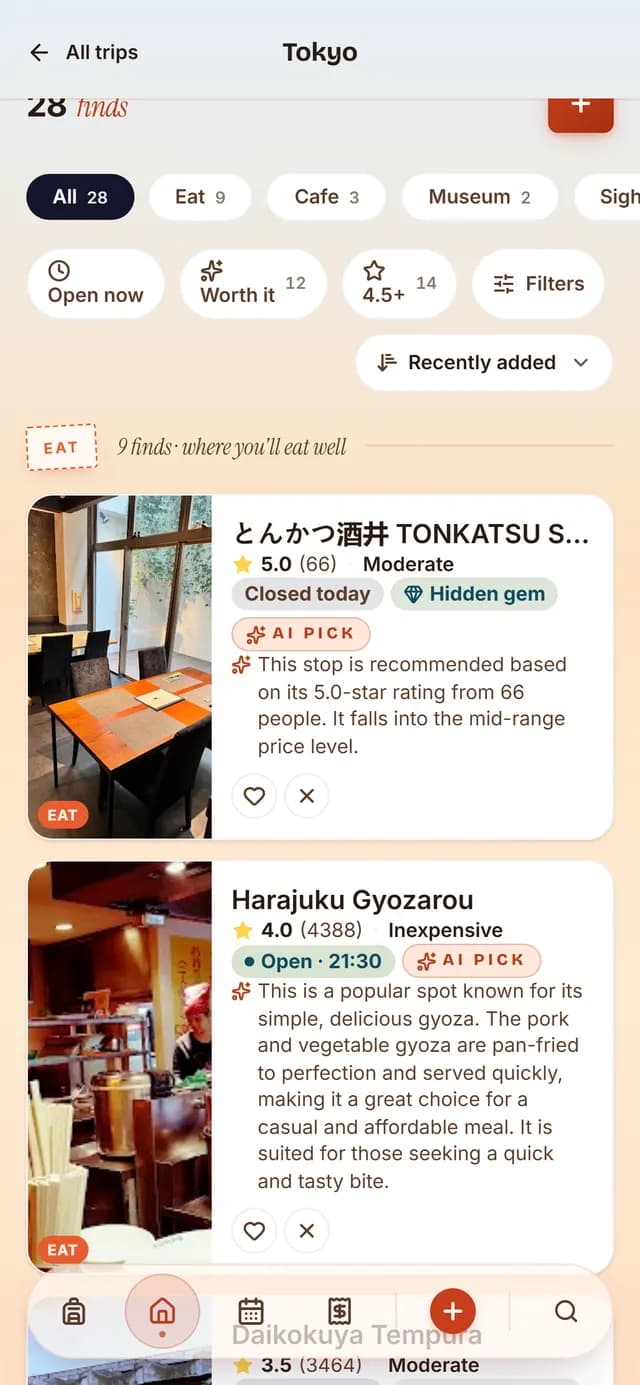
So the rule that fixed the trip was boring: one side of the city per day. Everything saved for that day has to sit inside a 25 minute walk of the other stops, or it gets moved to another day. That single constraint cut our transit time roughly in half and it is the same constraint the app applies when it builds a day.
- Shibuya and Shinjuku belong together.
- Asakusa, Ueno and Akihabara sit on one line and one mood.
- Harajuku, Omotesando, Daikanyama and Nakameguro are a slow day.
- Toyosu, Tsukiji and Ginza make a clean fourth day.
Where to stay, and why the train line beats the room
We stayed five nights near Shinjuku Sanchome, which is one stop from the giant Shinjuku station and about half as stressful. Any hotel within a five minute walk of a Yamanote or Oedo line station will do the same job. The room was small. Nobody cared by day two, because every morning started with a walk of under four minutes to a platform.
The alternative that keeps getting recommended, a bigger room near Tokyo station or in Asakusa, adds 20 to 35 minutes to each end of the day. Over five days that is roughly five hours, which is a whole extra day of Tokyo spent looking at the inside of a train.
Do not move hotels. Tokyo tempts you to split the stay between two districts for variety. Luggage days in Japan are easy but they still eat a morning, and coin lockers at big stations fill up faster than you expect on a weekend.
The only two things we booked in advance
Shibuya Sky sells timed slots and the sunset ones go first, often two to three weeks out in spring. We took the slot about 40 minutes before sunset, which gives you the city in daylight, the orange part, and then the lit version without queuing twice. Tickets were around 2,500 yen when bought online, a little more at the door if any are left.
teamLab Planets in Toyosu is the other one. It is timed entry, you walk through water barefoot, and the first slot of the day is noticeably calmer than anything after 11am. Around 3,800 yen. If your group is split on it, this is the rare case where the loud person is right.
Everything else stayed open. We booked exactly one dinner, a small izakaya in Shinjuku that a friend had been to, and skipped the ritual of reserving five restaurants for a group whose appetite we could not predict. Twice we ended up eating at 9:40pm because the day ran long, and a reservation would have just been a source of stress.
- Shibuya Sky: book the slot ~40 minutes before sunset.
- teamLab Planets: book the first slot of the day.
- Popular ramen counters: no reservations, just go early or late.
Trains, money and the small stuff that saves an hour
Get a Suica or Pasmo card, either the physical one or the version in your phone wallet. You tap in and out and stop thinking about fares. A Japan Rail Pass makes no sense for a Tokyo-only trip; it is priced for long shinkansen legs, not for the Yamanote line.
Carry some cash. Card acceptance is much better than it was five years ago, but the smallest and best places, the ones with six seats and a ticket machine at the door, are frequently cash only. Convenience store ATMs take foreign cards and are open all night.
Save the hotel address in Japanese offline, on every phone in the group, not just the phone of the person who booked it. We split up twice on purpose and once by accident. The accident happened in Shinjuku station, which is exactly where you would expect it to.
What we got wrong
Day two ran too long. We put Senso-ji, Ueno Park and Akihabara in one day, which is geographically sensible and about 90 minutes more walking than anyone wanted by 7pm. If I did it again I would drop Ameyoko market or start Senso-ji at 7:30am, when the temple approach is genuinely quiet and the shops are still shuttered.
We also underrated the department store food halls. The basement of any big store is a better lunch than most of the places we had saved from videos, costs less, and takes 15 minutes instead of 50. That is not a hidden gem, it is just a thing nobody makes short-form video about because there is no queue to film.
And Tokyo Tower was a mistake. Nice from the outside, and the observation deck is the one place where the price and the queue did not match the payoff. The group vote had it at three yes and one no. The one no was right.
The rainy Thursday, and what replanning actually looks like
Thursday was supposed to be Harajuku, Daikanyama and a long walk along the Meguro river. It rained from 8am without stopping. We rebuilt the day in about a minute: the plan swapped the outdoor stops for the Nezu Museum, a long lunch in Omotesando and the shops under Shibuya Scramble Square, and it kept the two stops that were already fixed.
The part that mattered was not the algorithm. It was that nobody had to redo the map in their head, and the person who had researched the river walk did not have to feel like their day got deleted. It moved to Saturday, which had been left open on purpose.
Leave one day empty. Every group I have travelled with either fills it with the thing they keep talking about, or uses it to recover from the day that went 14 hours. Both are good outcomes. A trip with no slack turns weather into an argument.
Day by day
The five-day Tokyo itinerary, as planned and as walked
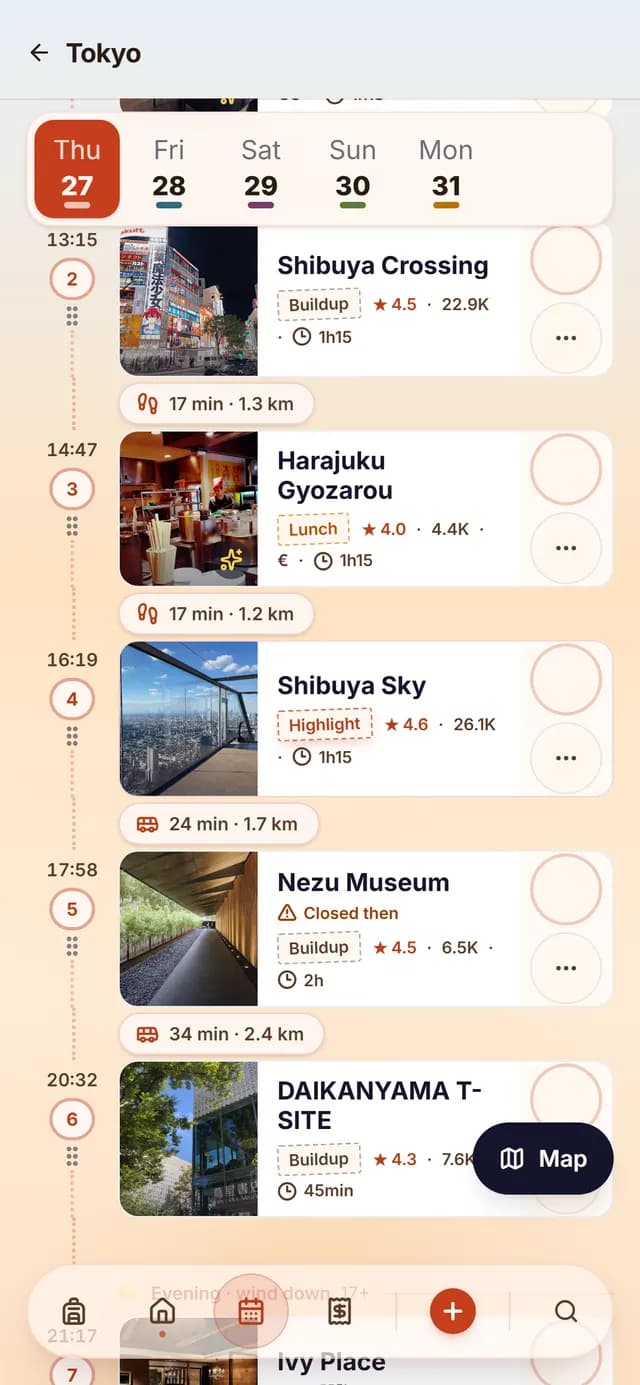
This is the plan the app built from our voted spots and the times we actually hit. Walking distances are the ones the day plan calculated, not estimates written afterwards. Two stops carry a booking; everything else is open.
Day 1
Shibuya and Shinjuku
Shibuya, then west to Shinjuku8.4 km on foot
- 10:30
Meiji Jingu
Sight · 1h 15m
Enter from the Harajuku side. The gravel approach under the trees is the point, not the shrine building.
- 12:15
Lunch in Yoyogi backstreets
Food · 1h
Set lunch menus are cheap and fast until about 14:00, then kitchens take a break.
- 13:45
Shibuya Scramble Crossing
Sight · 30m
Best view is free from the Starbucks window upstairs or the walkway at Shibuya Station.
- 14:30
Record and vintage shops, Udagawacho
Walk · 1h 30m
The strip north of the crossing. Fifteen shops in six blocks, no transit needed.
- 16:45
Shibuya SkyBooked
Sight · 1h 15m
Timed ticket ~2,500 yen. Slot 40 minutes before sunset gets you both versions of the view.
- 18:30
Omoide Yokocho, Shinjuku
Food · 1h 30m
Yakitori alley by the west exit. Small, smoky, mostly cash. Go before 19:00 for a seat.
- 20:30
Golden Gai
Evening · open ended
Six alleys of tiny bars. Many charge a seat fee of 500 to 1,000 yen. Check the door sign first.
Verdict. The strongest first day. Jet lag matches an afternoon start, and both districts stay good after dark.
Day 2
Asakusa, Ueno and Akihabara
North-east Tokyo, one line end to end10.9 km on foot
- 07:45
Senso-ji
Sight · 1h
Free, always open. At this hour Nakamise is shuttered and the approach is empty. By 10:00 it is a different place.
- 09:00
Nakamise-dori as it opens
Walk · 45m
Shops raise the shutters between 09:00 and 10:00. Melonpan and ningyo-yaki for breakfast.
- 10:15
Sumida river walk to Azumabashi
Walk · 30m
Flat, ten minutes, and the one angle where the Skytree photo works.
- 11:30
Ueno Park
Sight · 1h 30m
In late March the cherry trees along the central path are the reason to come. Otherwise use it as a route to the museums.
- 13:00
Lunch at Ameyoko
Food · 1h
Market street under the tracks. Loud, cheap, good. Skip if the group is already tired.
- 14:30
Tokyo National Museum
Sight · 2h
About 1,000 yen. The Honkan building alone is enough; do not try to see all six.
- 17:00
Akihabara
Walk · 2h
Two stops south. Arcades on the ground floor, retro games upstairs, and the good electronics are in the side streets, not on Chuo-dori.
- 19:30
Standing sushi near Akihabara
Food · 45m
Fast, cheap, no reservation. A useful format when everyone is done talking.
Verdict. The longest day of the trip. Cut one stop if your group is not used to walking.
Day 3
Harajuku, Omotesando, Daikanyama, Nakameguro
The slow, southern loop7.2 km on foot
- 10:00
Takeshita-dori
Walk · 30m
Twenty minutes is enough. Go early or it becomes a shuffle.
- 10:45
Omotesando architecture walk
Walk · 1h
Free. The flagship stores are the attraction from the pavement: Prada, Tods, Dior. No need to go in.
- 12:00
Nezu Museum and garden
Sight · 1h 30m
About 1,400 yen. The garden behind the museum is the quietest place we found in central Tokyo.
- 14:00
Lunch in Aoyama
Food · 1h 15m
Quieter and better value than Omotesando itself two streets away.
- 15:45
Daikanyama T-Site
Coffee · 1h 15m
A bookshop you can sit in for an hour with a coffee and nobody minds.
- 17:15
Meguro river walk to Nakameguro
Walk · 45m
Fifteen minutes downhill along the water. In late March this is the cherry blossom stretch and it gets crowded after dark.
- 18:30
Dinner in NakameguroBooked
Food · 2h
The one table we reserved. Small izakaya, six seats at the counter, worth the single booking.
Verdict. The day people were most surprised by. Almost no queues and the best coffee of the trip.
Day 4
Toyosu, Tsukiji and Ginza
Bay side, then back into the centre6.8 km on foot
- 09:00
teamLab Planets, ToyosuBooked
Sight · 1h 45m
First slot of the day, ~3,800 yen. Barefoot, knee-deep water in two rooms. Wear shorts or trousers that roll up.
- 11:30
Tsukiji Outer Market
Food · 1h 30m
The inner wholesale market moved to Toyosu, the outer market stayed and is the better visit. Most stalls close around 14:00.
- 13:30
Hamarikyu Gardens
Sight · 1h
About 300 yen. A tidal garden with a tea house on an island, surrounded by towers. Ten minutes on foot from Tsukiji.
- 15:00
Ginza on foot
Walk · 1h 30m
On weekend afternoons Chuo-dori closes to cars. Ginza Six and Itoya are worth a floor each.
- 16:45
Depachika at a Ginza department store
Food · 45m
Basement food hall. Best value meal of the trip and it takes fifteen minutes.
- 18:30
Free evening
Open · open ended
We split here. Two went to a jazz bar in Ginza, two went back to Shinjuku. Nobody had to negotiate.
Verdict. The most efficient day. One booking anchors it and the rest falls into place.
Day 5
The open day
Decided the night before9.6 km on foot
- 10:30
Shimokitazawa
Walk · 3h
Eight minutes from Shibuya. Secondhand shops, tiny cafes, no big sights, which is the appeal.
- 13:30
Lunch in Shimokitazawa
Food · 1h
Curry is the local speciality here for reasons nobody could explain to us.
- 15:00
Shinjuku Gyoen
Sight · 2h
500 yen, closes earlier than you think (last entry around 16:00 in most seasons). Big enough to lose the crowd.
- 17:30
The Meguro river walk we lost to rain
Walk · 1h
Rescheduled from Thursday. This is why the open day exists.
- 19:00
Last dinner, Shinjuku
Food · 2h
Booked on the day at 17:00 by phone from the park bench.
Verdict. This is the day everyone talked about afterwards, and it was the one with no plan until Thursday night.
Day six was a late flight, so it turned into a slow breakfast, luggage in a coin locker at the hotel, and two hours in a department store buying things for people at home. Narita is around 90 minutes from Shinjuku on the Narita Express, Haneda about 40 by monorail and train. Leave more slack than you think if you are flying from Narita on a weekday.
Honest comparison
Wanderlog, TripIt and Google Maps lists: what they do and where they stop
Before this trip we had our places spread across four tools, which is the normal state of affairs. Someone had a Google Maps list, someone else had a Wanderlog board, the flights were in a TripIt inbox, and the actual decisions were happening in a WhatsApp thread where nobody could find anything from last Tuesday.
None of those tools are bad. They each solve one slice. The problem is that the slices do not talk to each other, and the gaps between them are where group trips fall apart.
| What | Wanderlog, TripIt, Maps lists | TripSake |
|---|---|---|
| Getting places in | Wanderlog and Google Maps lists want you to search for a place by name and save it. TripIt wants a confirmation email. TripCase built its whole product on that same inbox model. | Paste the Reel, TikTok or Short. TripSake watches the video, pulls out every place mentioned or shown, and pins them with photos, ratings and opening hours. That is where most saved places come from now, and typing names into a search box is the slow path. |
| Deciding as a group | Shared editing, comments and reordering. Whoever edits last wins, and the quiet person in the group never says they hate the aquarium. | Every spot gets a yes or no vote, plus polls for the bigger calls. Friends vote through the invite link without making an account, so the person who never installs anything still gets a say. |
| Turning saved places into a day | Wanderlog auto-routes a day you have already assembled. Google Maps lists do not have days at all. TripIt only sequences what arrived by email. | The plan is built from the votes: it clusters spots geographically, checks opening hours, puts meals in meal slots, keeps timed tickets fixed, and tells you the walking time between each stop. One tap rebuilds it when the weather turns. |
| Bookings and documents | TripIt is genuinely good at this and has been for fifteen years. Wanderlog handles it as an attachment. | Forward the confirmation to the trip address and it lands in the booking vault, resolved to the actual venue rather than a street name, and anchored into the day plan at the right time. |
| Money | Separate app. Usually Splitwise, sometimes a spreadsheet, occasionally nothing until the flight home. | Expenses live in the trip. Scan the receipt, split it, settle once at the end. It is the same four people who are already in the trip, so there is no second invite round. |
| Price | Wanderlog has a free tier and a paid Pro subscription. TripIt has a free tier and TripIt Pro, billed yearly. Both put the useful bits behind the recurring charge eventually. | Free. There is no Pro tier, no subscription, no per-trip charge and no feature that unlocks when you pay, because there is nothing to pay. Maps, voting, day plans, expenses, offline mode and Wrapped are all just there. |
If your trip is a solo business flight and you want the itinerary assembled from your inbox, TripIt still does that better than anyone. If your trip is four friends, a folder of saved Reels and a group chat that has stopped scrolling, the missing piece is not another list. It is somewhere the decision gets made and then becomes a real day with times on it.
Questions travellers ask
Before you book
How many days do you need in Tokyo for a first visit?
Five full days plus arrival and departure. That covers Shibuya and Shinjuku, the Asakusa and Ueno side, the Harajuku to Nakameguro loop, the Toyosu and Ginza day, and one open day. Fewer than four days means cutting a district entirely rather than rushing all of them.
What should you book in advance for Tokyo?
Shibuya Sky and teamLab Planets, both timed entry, ideally two to three weeks out for sunset and morning slots. Everything else can be decided on the day. Restaurants generally do not need reserving unless the place is famous for a queue.
Is the Japan Rail Pass worth it for a Tokyo-only trip?
No. The pass is priced around long-distance shinkansen travel. For a trip inside Tokyo, a Suica or Pasmo card on your phone is cheaper and simpler.
Which Tokyo neighbourhoods work well together in one day?
Shibuya with Shinjuku; Asakusa with Ueno and Akihabara; Harajuku with Omotesando, Daikanyama and Nakameguro; Toyosu with Tsukiji and Ginza. Grouping this way cuts roughly half the transit time of a fame-ordered list.
How much walking is a Tokyo day?
Between 7 and 11 kilometres on this itinerary, plus about 90 minutes a day of trains and station walking. Station transfers are the part most people underestimate.
What is the best app for planning Tokyo with friends?
The useful test is whether the tool turns a shared list into a dated day with times. Google Maps lists save places but have no days. Wanderlog routes days you assemble yourself. TripIt organises confirmation emails. TripSake takes saved videos, runs a group vote and builds the day plan from the result, and it is free with no subscription tier.
Do you need cash in Tokyo?
Cards work almost everywhere now, but small counter restaurants, older bars in Golden Gai and some market stalls are still cash only. Convenience store ATMs accept foreign cards around the clock.
Is Tokyo Tower worth visiting?
The building is good from the street. The observation deck was the one paid view on this trip where the queue and price did not match what you get, especially if you have already booked Shibuya Sky.
About the author
Mara plans routes for the TripSake travel desk and has spent about five months in Japan across seven trips since 2017. She writes the itineraries we test in the app before they go out.
Keep reading