Travel guide
Porto and the Douro in five days: three nights in the city, two up the river
Porto is small enough to walk and steep enough to regret it. The valley is the part most people cut, and it is the part worth keeping.
By TripSake travel desk · Published · Updated · 10 min read
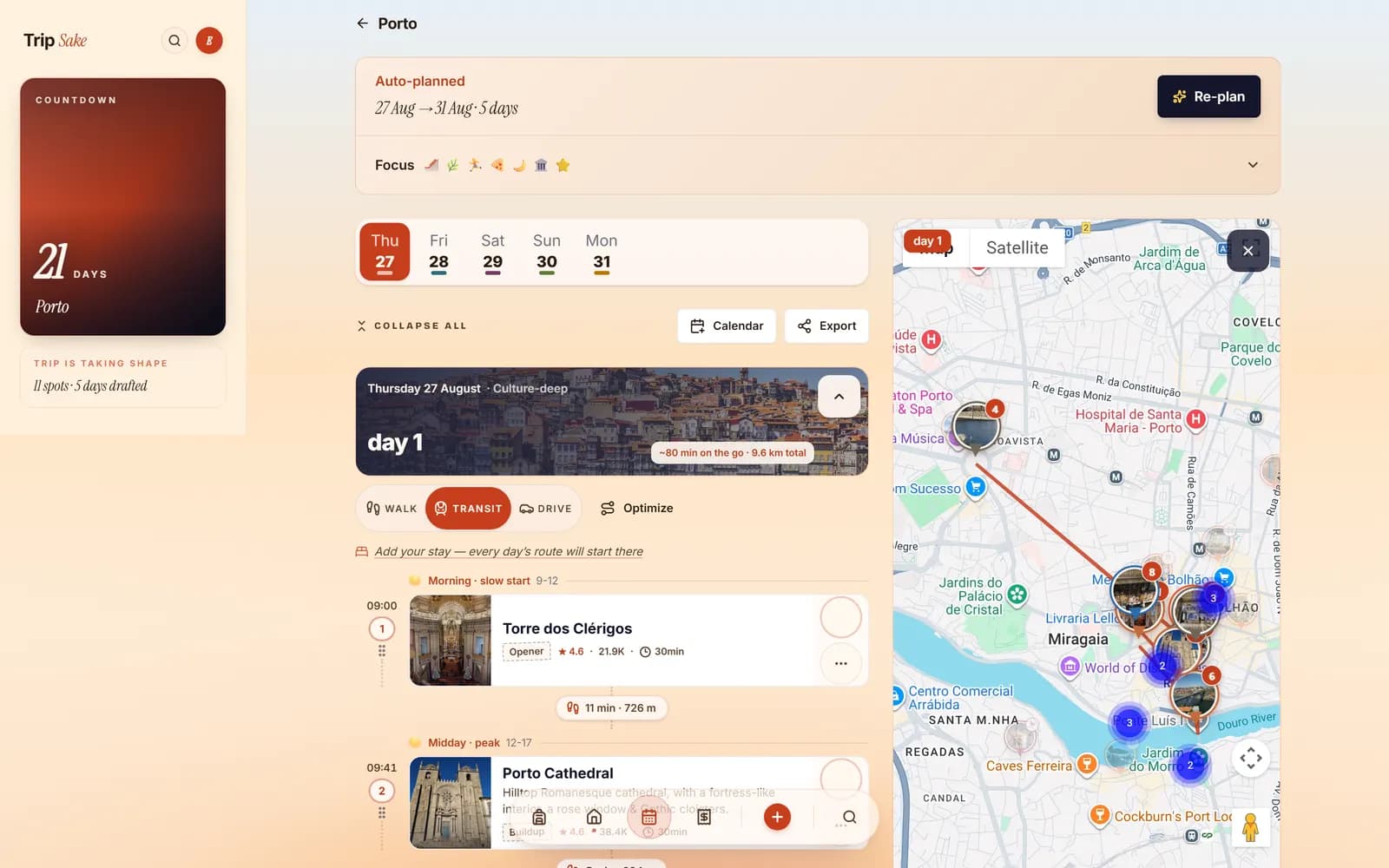
- Trip length
- 5 nights
- Group
- 6 people, two non-drinkers
- Split
- Porto 3 nights, Pinhao 2 nights
- Transport
- Trains and one taxi. No car.
- Booked ahead
- 1 lodge tour, 1 quinta visit, 2 dinners
- Season
- Late September, harvest
The short answer
Five days splits cleanly into three nights in Porto and two in the Douro Valley. Take the Linha do Douro train to Pinhao and sit on the right-hand side after Regua. Porto itself is a two-day city; the third day is for the coast or a slow morning. No car needed for any of it.
What to take away
- Porto is two days of sights and one day of nothing. Plan it that way.
- The train to Pinhao is one of the best rail journeys in Europe and costs under 15 euros.
- Book one port lodge tour, not three. They are broadly the same tour.
- Stay two nights in the valley. A Douro day trip is five hours of travel for three hours of valley.
- Everything in Porto is uphill from the river. Plan the direction, not just the stops.
Porto is a two-day city and that is a compliment
The historic centre of Porto is about two kilometres across and most of what you came for sits inside it: the Ribeira waterfront, Sao Bento station, Livraria Lello, Clerigos tower, the cathedral, and the bridge. You can see all of it properly in two days without hurrying.
The mistake is stretching that into four days and then filling the gap with things that were never worth doing. The better use of a fifth day is to leave the city entirely.
The other thing to understand is the gradient. Porto is built on a slope down to the Douro, and the difference between the cathedral and the Ribeira waterfront is about 60 vertical metres of stairs and cobbled ramps. Every walk is either a descent or a climb, and if you plan by map distance you will arrange four climbs into one afternoon.
- Day 1: the upper town, ending downhill at the river.
- Day 2: cross to Gaia, the lodges, and back over the top deck of the bridge.
- Day 3: coast, or nothing, or Matosinhos for lunch.
The port lodges: book one, not three
Vila Nova de Gaia, across the river, is where the port houses have their cellars. Taylor's, Graham's, Sandeman, Ferreira, Croft and a dozen others all run tours, all lasting about 45 to 60 minutes, all following the same shape: a walk through barrel rooms, an explanation of fortification, a tasting of three.
They are good. They are also, after the first one, the same. We booked one (Graham's, which is up a hill and has the best terrace) and then spent the saved time drinking in the Gaia bars along the water, which cost a fraction and had better views.
For the two people in our group who do not drink, Gaia was still worth the afternoon: the Teleferico cable car down the hillside is about six euros and takes five minutes, and the walk back across the upper deck of the Dom Luis I bridge is the single best view in the city and is free.
Livraria Lello, and whether to bother
The bookshop with the red staircase charges an entry fee (around 8 euros, redeemable against a book) and has a queue outside it from opening. Inside, it is one small room with a famous staircase and roughly sixty people photographing it.
We went, at 09:30 with a pre-booked slot, and it was fine. Four minutes of genuine architectural pleasure and then a slow shuffle. Half the group thought it was worth it and half did not, which is a fair summary of the place.
If you skip it, spend the time at Sao Bento station instead, which is free, five minutes away, and has 20,000 azulejo tiles covering the entrance hall. It is the more impressive room and there is never a queue for it because it is a working railway station.
The train up the Douro is the trip
The Linha do Douro runs from Sao Bento up the river to Pocinho. Take it as far as Pinhao, about two hours and ten minutes, and sit on the right-hand side of the carriage. After Peso da Regua the line runs along the water with terraced vineyards climbing both banks, and for the last 40 minutes it is genuinely one of the best train rides in Europe.
It costs somewhere around 14 euros. No reservation, no first class, no drama. You buy a ticket at Sao Bento and get on. There are river cruises that cover part of the same route for ten times the price and take twice as long.
Do not do this as a day trip. Porto to Pinhao and back is four and a half hours of travel for a few hours in the valley, and you will arrive at the moment the light gets good and have to leave. Two nights in Pinhao or Regua turns the journey into the point rather than the cost.
Two nights in the valley, in harvest season
Pinhao is tiny. A station with tiled panels, a bridge, a handful of restaurants, and quintas up every road out of it. That is the whole town and it is enough for two nights, because the point is the valley rather than the settlement.
Book one quinta visit properly, ideally one you can walk or take a short taxi to. In late September several of them let you see the harvest, and at a few you can still tread grapes in the lagares, which sounds like a tourist gimmick and is actually how a lot of port is still made. Ours was about 25 euros with a tasting.
The other thing to do is the Miradouro de Sao Leonardo da Galafura, which is a viewpoint about 20 minutes by taxi from Regua and looks down the valley from 600 metres. Go at the end of the day. It is free, it is usually empty, and it is the image the whole region is selling.
What we got wrong
We booked the return train to Porto at 09:20 on the last morning, which meant leaving the valley before the mist burned off the terraces. The 13:00 train would have cost us nothing and given us the best morning of the trip. The plan flagged that the flight was at 19:40 and there was no need for the early train, and we booked it anyway before anyone looked.
We also over-booked dinners in Porto. Three reservations for six people across three nights, of which one was a genuinely good decision (Saturday) and two locked us into walking across the city when everyone wanted to eat where they already were.
And francesinha. It is the local sandwich: bread, several meats, melted cheese, a beer and tomato sauce poured over the top, chips underneath. Everybody should eat one. Nobody should eat two, and one of us tried.
Day by day
Five days: Porto, then the Douro
Three nights in the city walking downhill wherever possible, then two nights upriver. One train each way, one taxi, no car at any point.
Day 1
Upper Porto, ending at the river
Clerigos down to Ribeira7.3 km on foot, almost all downhill
- 09:30
Livraria LelloBooked
Sight · 45m
Around 8 euros, redeemable against a book, timed slot. Go at opening or do not go.
- 10:30
Clerigos Tower
Sight · 45m
About 8 euros, 240 steps, narrow. The best orientation view of the city and it takes twenty minutes at the top.
- 11:45
Sao Bento station
Sight · 30m
Free, always open, 20,000 azulejo tiles. More impressive than the bookshop and there is no queue.
- 12:30
Lunch, Rua das Flores
Food · 1h 30m
Pedestrianised, downhill from the station, and the side streets off it are cheaper than the street itself.
- 14:30
Porto Cathedral and the terrace
Sight · 1h
A few euros for the cloister. The terrace outside is free and looks down over the whole Ribeira.
- 16:00
Walk down through Barredo to Ribeira
Walk · 1h
Steep, medieval, laundry everywhere. Do not attempt this uphill later.
- 17:30
Ribeira waterfront
Walk · 1h 30m
Touristy and worth it once, at the end of the day when the light is on the Gaia side.
- 20:30
Dinner, Ribeira backstreets
Food · 2h
One street back from the water the prices drop by about a third.
Verdict. Start high and let gravity do the routing. This is the whole trick in Porto.
Day 2
Gaia and the bridge
The south bank8.1 km on foot
- 10:00
Cross the lower deck of Dom Luis I
Walk · 20m
Free. Pedestrians share the lower deck with cars, the upper with the metro. Both walkable.
- 10:30
Graham's Lodge tour and tastingBooked
Sight · 1h 30m
Around 25 euros. Book one lodge, not three: they are broadly the same tour with different barrels.
- 12:30
Lunch, Gaia waterfront
Food · 1h 30m
The view of Porto from this side is better than the view of Gaia from that side.
- 14:30
Teleferico de Gaia
Travel · 30m
About 6 euros one way, five minutes, down the hillside to the river. Worth it for the angle.
- 15:30
Jardim do Morro
Sight · 1h
Free park at the Gaia end of the upper bridge deck. Where everyone in the city watches the sun go down.
- 17:00
Walk back on the upper deck
Walk · 30m
The best free view in Porto, 60 metres above the river. Not for anyone who dislikes heights.
- 19:00
Francesinha, somewhere unglamorous
Food · 1h 30m
The local sandwich under a beer and tomato sauce. Eat one. Do not eat two.
Day 3
The coast, or nothing
Foz and Matosinhos9.4 km on foot
- 10:30
Tram 1 to Foz
Travel · 30m
A wooden 1930s tram along the river to the sea for about 4 euros. Slow, which is correct.
- 11:15
Foz do Douro promenade
Walk · 1h 30m
Where the river meets the Atlantic. Flat, windy, and full of people from Porto rather than visitors.
- 13:00
Grilled fish in Matosinhos
Food · 2h
Rua Heroismo is a street of charcoal grills. Best meal of the trip and about 15 euros a head.
- 16:00
Serralves gardens and museum
Sight · 2h
Around 20 euros for both, less for the park alone. Eighteen hectares of gardens and an art deco house.
- 20:00
Dinner, CedofeitaBooked
Food · 2h
The one reservation that was worth it. Neighbourhood north of the centre with almost no visitors.
Verdict. The day with no monuments. Half the group did the whole thing, half stopped at Foz and had lunch.
Day 4
The train up the Douro
Pinhao5.6 km on foot
- 09:15
Linha do Douro from Sao Bento
Travel · 2h 10m
Around 14 euros, no reservation. Sit on the right-hand side. After Regua the line runs on the water.
- 11:40
Arrive Pinhao
Hotel · 30m
The station itself is tiled with azulejo panels of the harvest. Two minutes and worth them.
- 13:00
Lunch by the river
Food · 1h 30m
Pinhao has about six restaurants. This is not a problem.
- 15:00
Quinta visit and harvest tourBooked
Sight · 2h 30m
About 25 euros with tasting. In late September you can see, and at some quintas tread, the harvest.
- 18:30
Walk up the vineyard road
Walk · 1h
Any road out of Pinhao goes uphill into terraces. Twenty minutes up is enough for the view.
- 20:30
Dinner at the guesthouse
Food · 2h
Most quintas and guesthouses cook. In a village this size that is the sensible option, not a fallback.
Verdict. The best two hours of the trip happened through a train window for under 15 euros.
Day 5
The valley, then back
Regua and the viewpoint6.2 km on foot
- 09:30
Slow morning in the valley
Open · 2h
The mist sits on the terraces until about 10:00. This is the thing we nearly missed by booking an early train.
- 12:00
Train to Peso da Regua
Travel · 25m
Twenty-five minutes downriver. Regua is bigger, duller, and has the transport.
- 13:00
Lunch, Regua
Food · 1h 15m
Riverside and unremarkable, which after two days of quinta cooking is fine.
- 14:45
Miradouro de Sao Leonardo da Galafura
Sight · 1h 30m
Free, about 20 minutes by taxi from Regua. Six hundred metres up, looking down the whole valley. Agree the return with the driver.
- 17:20
Train back to Porto
Travel · 2h
Roughly two hours to Sao Bento, arriving with time for a last dinner before a late flight.
Porto airport is about 30 minutes from the centre on metro line E, which runs to Trindade and costs a few euros. It is one of the easier airport connections in Europe and there is no reason to take a taxi unless you have an early flight and a lot of luggage.
Honest comparison
Six people, two of whom never open the app
This trip had a specific problem that no feature list ever addresses: two of the six were never going to install a planning app. Not out of principle, just out of the ordinary human unwillingness to make a sixth account this month.
That single fact rules out most tools, because a trip that only four of six people can see is not a shared trip.
| What | Wanderlog, TripIt, Maps lists | TripSake |
|---|---|---|
| Getting everyone in | Wanderlog, TripIt and most others require an account per participant before that person can see or do anything. Realistically the plan ends up being screenshotted into a group chat. | One invite link. Guests open it and immediately see the trip, vote on spots and add their own, with no sign-up. Two of our six never made an account and were still fully in the trip, including the expense split. |
| From a video to a place | Search by name and save a pin. Which requires you to already know the name, which is the one thing a fifteen second clip does not tell you. | Paste the link and the places in the video get identified and pinned with photos, ratings and opening hours, with the clip attached. |
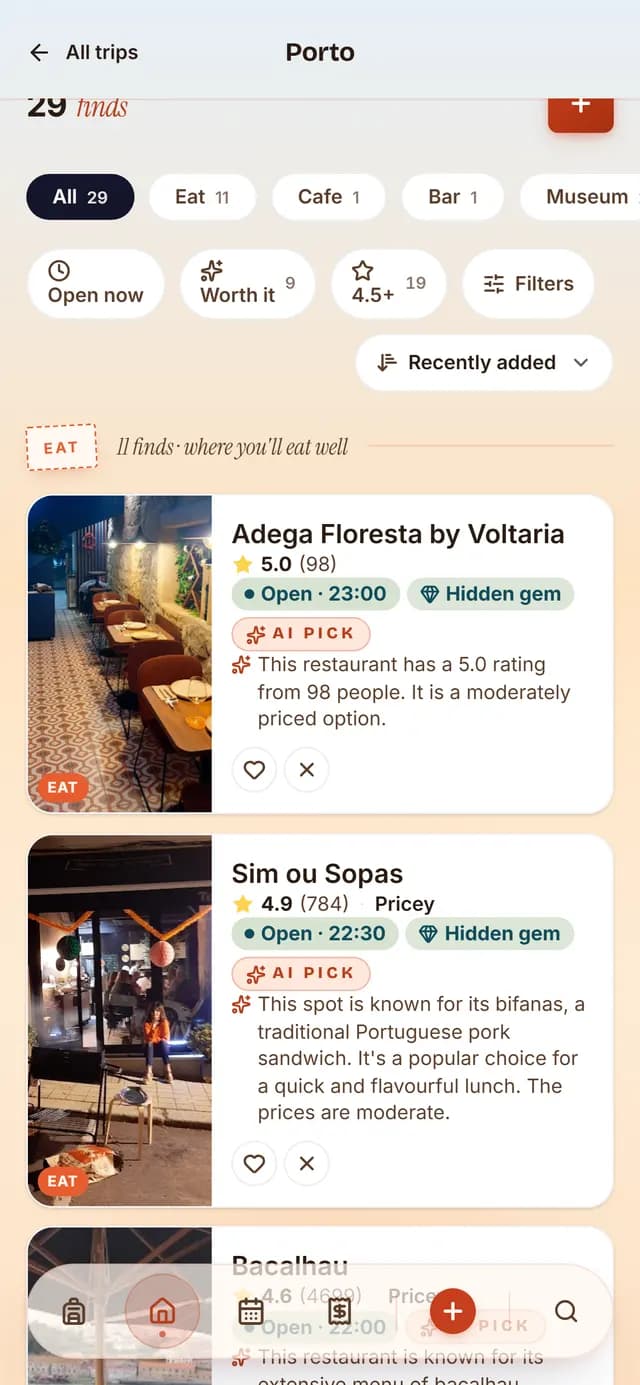
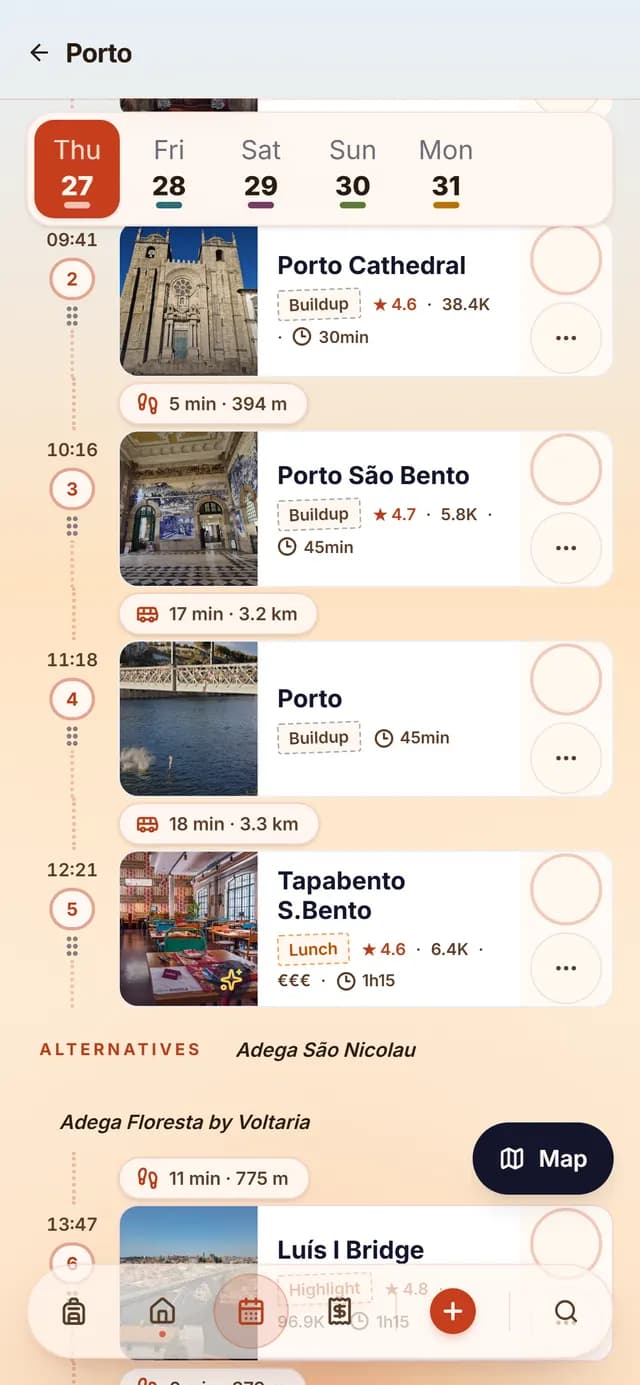
| The gradient problem | Distance on a map, or a manual route check in a second app. Porto is the city where that gap costs you most. | Real walking routes between stops, so the plan knows the cathedral to Ribeira leg is a descent and does not schedule it in reverse at 19:00. |
| Trains in the middle of a trip | TripIt handles the confirmation. It does not know that the 09:20 train wastes your best morning when the flight is at 19:40. | The train sits in the day plan as an anchor with the day built around it, and it flagged exactly that conflict. We ignored the flag, which is on us and not on the app. |
| Splitting six ways | Splitwise, in a separate group, with the two non-app people added by phone number and then forgotten. | Expenses live in the trip with the same six members, guests included. Photograph the receipt, split, settle once. |
| Cost | Wanderlog Pro and TripIt Pro are annual subscriptions. | Free with no subscription and no paid tier. Relevant here mostly because asking six people to each consider a subscription is a conversation that ends the trip planning. |
The deciding feature for a group this size was not routing or offline maps. It was that two people who would never make an account could still vote, see the plan and pay their share. Everything else is downstream of getting everyone into the same trip.
Questions travellers ask
Before you book
How many days do you need in Porto?
Two days covers the historic centre and Gaia properly. A third is worth it for the coast at Foz and Matosinhos. Beyond that you are better off spending the time in the Douro Valley.
Is the Douro Valley worth a day trip from Porto?
Not really. Porto to Pinhao and back is around four and a half hours of travel for a few hours in the valley, and you leave just as the light gets good. Two nights upriver makes the journey the point rather than the cost.
How do you get from Porto to the Douro Valley without a car?
The Linha do Douro train from Sao Bento to Pinhao takes about two hours ten minutes and costs somewhere around 14 euros with no reservation needed. Sit on the right-hand side; after Peso da Regua the line runs along the water.
How many port lodges should I visit in Gaia?
One. The tours all run 45 to 60 minutes and follow the same structure through barrel rooms to a tasting of three. Spend the remaining time on the Gaia waterfront bars or walking the upper deck of the bridge, which is free.
Is Livraria Lello worth the entry fee?
It is one small room with a famous staircase and a permanent queue, for around 8 euros redeemable against a book. Go at opening with a timed slot or skip it and spend the time at Sao Bento station, which is free and arguably the better room.
Can guests use a trip planner without creating an account?
In most tools, no. TripSake works from a single invite link: guests see the trip, vote on spots, add places and take part in the expense split without signing up at all.
When is harvest season in the Douro?
Roughly mid September to mid October, depending on the year and the altitude of the vineyard. Several quintas run harvest visits then, and a few still let visitors tread grapes in the stone lagares.
About the author
The TripSake travel desk plans and walks the routes we publish. This one came out of a harvest-season trip for six people, two of whom do not drink and still rated it the best week of the year.
Keep reading