Travel guide
Seven days in Madeira: levadas, one big ridge walk and the north-south weather split
The island has two climates twenty minutes apart. Half of planning a week here is knowing which side of the mountain to be on.
By TripSake travel desk · Published · Updated · 12 min read
- Trip length
- 7 nights, March
- Group
- 4 people, all walkers
- Bases
- Funchal 4 nights, Sao Vicente 3
- Car
- Small hatchback, about 30 euros a day
- Daily walking
- 7 to 15 km, up to 1,000 m of climb
- Season
- March, 16 to 21 degrees, rain on the north coast
The short answer
Seven days is right for Madeira: five or six walking days and one for Funchal. Hire a car, because the levada trailheads are scattered and the buses are slow. Watch the forecast for the north coast and the south separately, do the Arieiro to Ruivo ridge on the clearest morning of the week, and start it before sunrise if you want it to yourself.
What to take away
- North and south have different weather. Check both forecasts, every morning.
- Arieiro to Ruivo is the best walk on the island. Go at dawn, not at ten.
- Levada walks are flat and long. The tunnels need a torch and a waterproof.
- A car is essential. The tunnels make the island small and the roads make it slow.
- Fanal is a fog forest. On a clear day it is a field with trees in it.
Two islands, one mountain in the middle
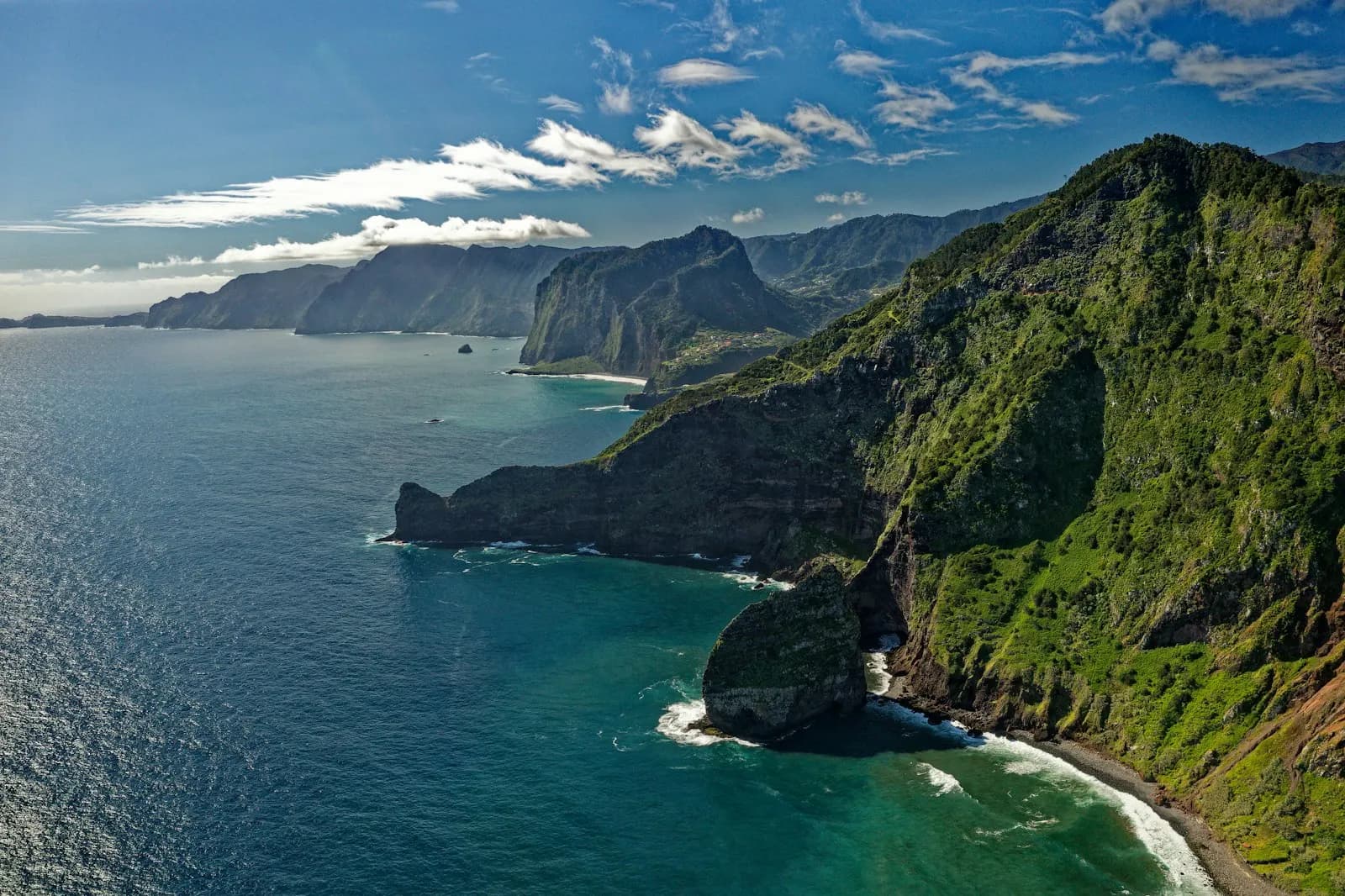
Madeira is a volcanic ridge sticking out of the Atlantic, and the ridge splits the weather in half. The south coast, where Funchal is, is dry and sunny far more often than not. The north coast gets the cloud, the rain and the green. In March we drove through a tunnel in sunshine and came out the other side in fog with the wipers on full.
This is the single most useful thing to know when planning a week here. Do not check "the weather in Madeira", check the forecast for the specific coast and the specific altitude you are going to be at. The mountain forecast is a third thing again, and on the high ridge it can be clear above a cloud layer that makes the whole island look socked in from below.
The practical version: keep a north-coast day and a south-coast day both ready to go, and decide at breakfast. We ended up doing exactly that four times in seven days.
- South: Funchal, Camara de Lobos, Cabo Girao, Ponta de Sao Lourenco.
- North: Sao Vicente, Seixal, Porto Moniz, the Caldeirao Verde levada.
- High: Arieiro, Ruivo, Balcoes. Often clear above cloud on a grey morning.
- East: Sao Lourenco is a desert peninsula and is windy every single day.
The ridge walk, and why it starts in the dark
Pico do Arieiro to Pico Ruivo is the walk people come to Madeira for: about 7 kilometres each way along the crest between the two highest peaks, through tunnels cut into the rock, on stairs bolted to cliffs, above a sea of cloud when it behaves. It is genuinely spectacular and it is genuinely exposed.
The car park at Arieiro fills before dawn, because the sunrise from there has become one of the more photographed things in Portugal. That is the reason to go early, and it also happens to be when the trail is at its best: cool, quiet, and with the cloud still sitting in the valleys.
The practical bits: it is a there-and-back unless you arrange a car at the Achada do Teixeira end, which is what we did with two cars. There are three tunnels and you need a torch. The trail closes in bad weather and the closures are enforced and correct. Allow five to seven hours for the full return and take more water than seems reasonable.
Levadas: flat, long and not always easy
The levadas are irrigation channels cut across the island over five hundred years, and the maintenance paths beside them are now the walking network. They are close to flat, which sounds easy, and they are frequently a metre-wide ledge with a drop on one side and no railing.
Caldeirao Verde is the classic: about 13 kilometres return from Queimadas through laurel forest and four tunnels to a waterfall in an amphitheatre of rock. Bring a head torch and a waterproof, because the tunnels drip continuously.
The 25 Fontes and Risco levadas above Rabacal are the other famous pair, and they now run a shuttle from the main road because the access track cannot take the traffic. Vereda dos Balcoes is the short one, half an hour each way, and on a clear day it looks straight into the central massif; it is the best return on effort on the island.
Funchal, and the things that are worth a slot
Funchal is a proper small city, not a resort strip. The Mercado dos Lavradores is worth an hour in the morning, with the caveat that the fruit sellers upstairs will hand you slices and then charge for them; ask the price first and everyone stays friendly.
The cable car up to Monte and the toboggan back down is the famous combination. The toboggan is a wicker sledge steered by two men in straw hats, it costs around 30 euros for two people, it lasts about ten minutes, and it is exactly as ridiculous as it sounds. Do it once. The Monte Palace garden at the top is genuinely good and takes two hours.
And then there is poncha, a rum drink from Camara de Lobos that goes down like fruit juice and does not behave like it. The traditional bars in Camara de Lobos, twenty minutes west, are where to try it, and the fishing harbour there is more pleasant than anywhere on the Funchal seafront.
What a week costs, and the four-way split
Madeira is good value by western European standards. A hire car ran about 30 euros a day in March, apartments in Funchal 90 to 130 a night for four, a good dinner with wine 20 to 25 a head, and a espetada, beef on a bay-laurel skewer hung over the table, for about 15.
Most trailheads now charge a small fee, typically a few euros a person, collected at the start or booked online, and the money goes to trail maintenance. It is worth knowing in advance so you are not standing at a barrier with no phone signal trying to pay.
For four people the split was simple in structure and annoying in volume: one car, one flat, twenty small payments a day for coffees, fees and parking. We logged them as we went. Total for seven days, excluding flights, was around 480 euros a head.

Day by day
Seven days on both coasts
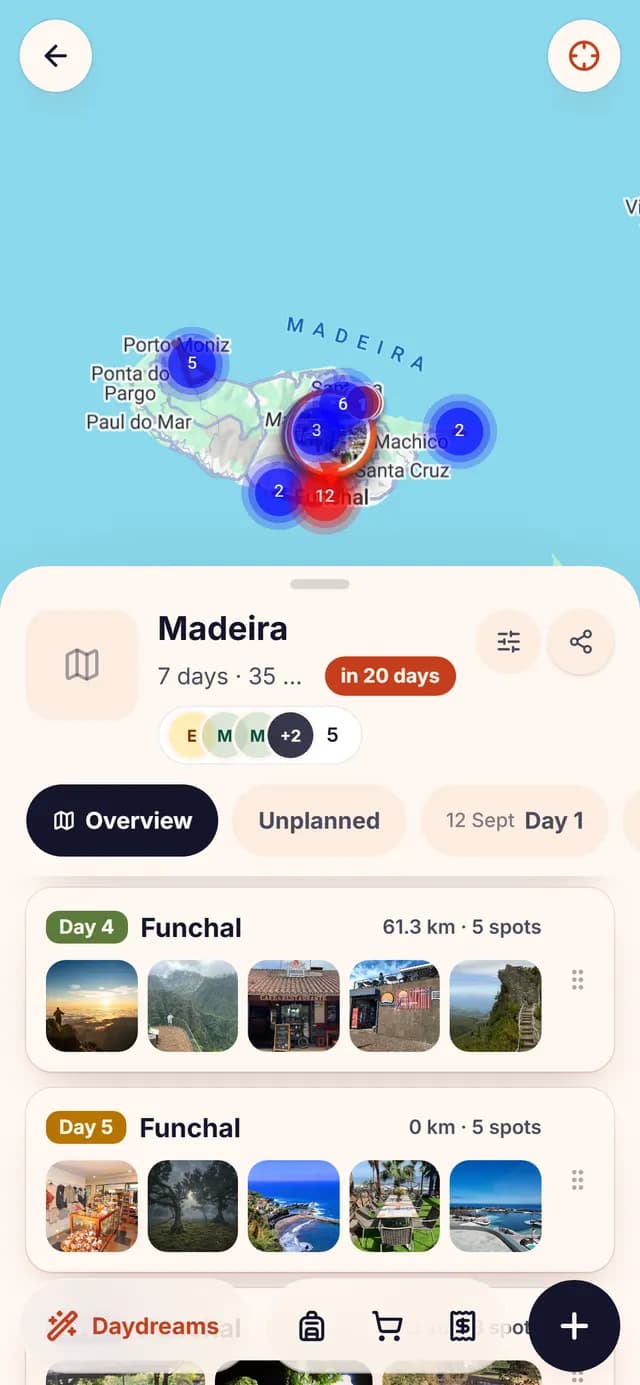
Four nights in Funchal and three in Sao Vicente on the north coast, which halves the driving. Hikes are listed in the order the weather gave them to us, not in a fixed sequence.
Day 1
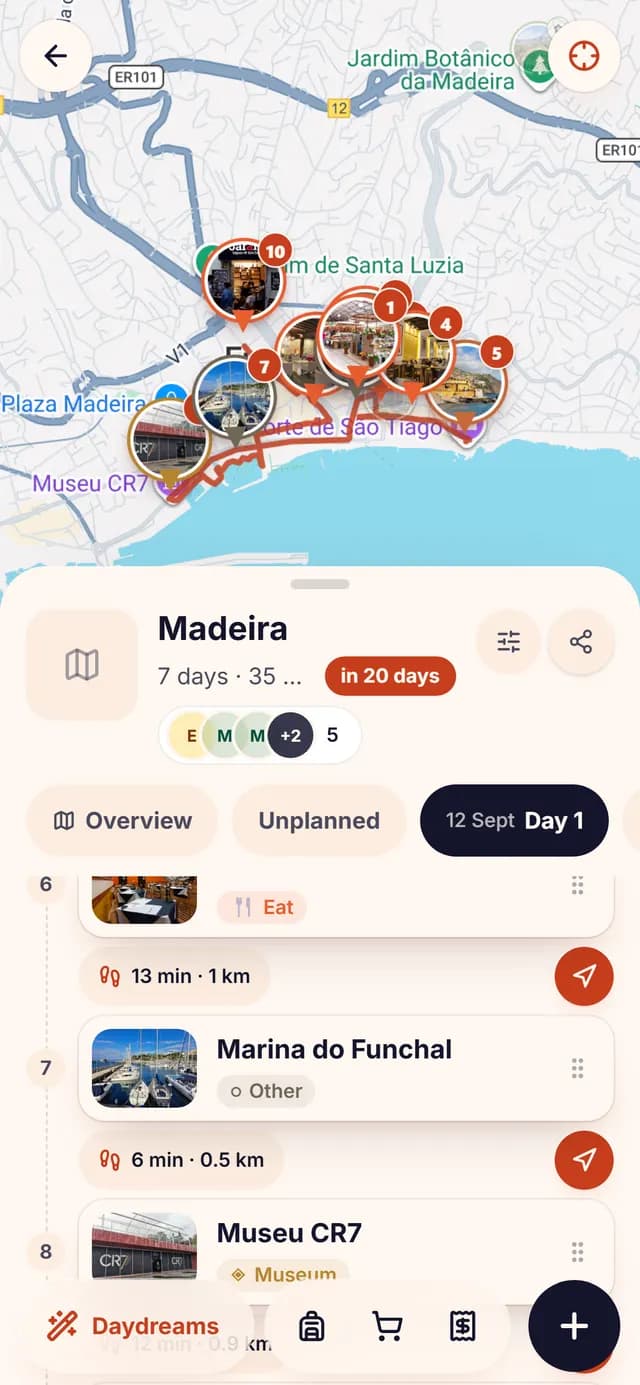
Funchal
Funchal old town9.6 km
- 09:30
Mercado dos Lavradores
Food · 1h 30m
Go early. Ask the price before accepting a slice of fruit and the whole exchange stays cheerful.
- 11:30
Cable car to Monte
Travel · 30m
Around 18 euros return, or 11 one way if you are taking the toboggan down.
- 12:00
Monte Palace tropical garden
Sight · 2h
Terraced garden with koi ponds and Portuguese tiles. Two hours, easily.
- 15:00
Toboggan down to Livramento
Sight · 30m
Around 30 euros for two. A wicker sledge, two men in straw hats, ten minutes, no regrets.
- 19:00
Espetada and poncha
Food · 2h 30m
Beef on a bay skewer hung over the table. The poncha is stronger than it tastes.
Verdict. Arrival day. The city takes one day, and it is a good one.
Day 2
Ponta de Sao Lourenco
Funchal, driving east8.2 km, exposed the whole way
- 09:00
Drive to the eastern tip
Travel · 45m
Forty-five minutes on the motorway. The car park fills by ten in season.
- 10:00
Sao Lourenco trail
Walk · 3h 30m
Free. A red and ochre desert peninsula with the Atlantic on both sides. Wind every day of the year, no shade at all.
- 14:30
Lunch in Canical
Food · 1h 30m
A working fishing town rather than a tourist one, five minutes from the trailhead.
- 17:00
Machico or the Caniçal whale museum
Sight · 2h
The museum is better than it needs to be and covers Madeira's whaling history honestly.
Verdict. The best bad-weather-on-the-north day. It is dry out here when everywhere else is not.
Day 3
Arieiro to Ruivo, on the clearest morning
Funchal, leaving before dawn14 km with 1,000 m of cumulative climb
- 05:30
Drive up to Pico do Arieiro
Travel · 1h
Forty minutes of hairpins from Funchal. The car park fills before sunrise in season.
- 06:30
Sunrise at 1,818 m
Sight · 45m
Free. Above the cloud layer more often than not, which is the whole reason for the alarm.
- 07:15
Ridge trail PR1 to Pico Ruivo
Walk · 3h 30m
Small trail fee. Three tunnels, so bring a torch. Stairs bolted to cliffs, exposed in wind, closed in bad weather and rightly so.
- 11:00
Pico Ruivo summit
Sight · 1h
The highest point on the island at 1,862 m. There is a rest house just below it that sells coffee.
- 14:00
Descend and drive back
Travel · 2h 30m
Return the way you came, or arrange a second car at Achada do Teixeira and halve the walking.
Verdict. The walk of the trip. It went on the day with the best mountain forecast, which was not the day we had planned it.
Days 4 to 5
North coast: Sao Vicente, Seixal, Porto Moniz
Sao Vicente6 to 13 km
- 10:00
Drive north through the tunnels
Travel · 1h
Twenty-five minutes and a complete change of climate. The old coast road, where it survives, is the scenic alternative.
- 12:00
Seixal black sand and the natural pools
Open · 2h 30m
Volcanic sand, green cliffs, and a swimming spot that is spectacular when the swell is down and closed when it is not.
- 10:00
Levada do Caldeirao Verde
Walk · 5h
About 13 km return from Queimadas. Four dripping tunnels, laurel forest, a waterfall at the end. Torch and waterproof.
- 17:00
Porto Moniz lava pools
Open · 2h
A few euros for the maintained pools. Natural rock enclosures filled by the Atlantic, and cold in March.
Verdict. Moving north for three nights removed two hours of driving a day. Worth it.
Day 6
Fanal and the west
Sao Vicente7.4 km
- 09:00
Fanal forest
Walk · 2h 30m
Free. Ancient laurel trees on a plateau, extraordinary in fog and unremarkable in sunshine. Check the webcam before you drive up.
- 13:00
Lunch in Porto Moniz or Achadas da Cruz
Food · 1h 30m
The cable car at Achadas da Cruz drops 450 metres to a farming terrace by the sea and is not for the nervous.
- 15:30
Rabacal, 25 Fontes and Risco
Walk · 3h 30m
Shuttle from the main road, small fee. Two levadas from one trailhead and the busiest walk on the island in summer.
Verdict. Fanal is a gamble and it is the only one on this list. Go when the fog is in.
Day 7
Back south, slowly
Funchal6 km
- 10:00
Vereda dos Balcoes
Walk · 1h 30m
Free, half an hour each way, and on a clear day it looks straight into the central massif. The best effort-to-view ratio on Madeira.
- 13:00
Camara de Lobos
Food · 2h 30m
Fishing harbour twenty minutes west of Funchal, and where poncha comes from. Better than anywhere on the Funchal front.
- 16:30
Cabo Girao skywalk
Sight · 1h
A glass platform 580 metres above the sea. Small fee, ten minutes of your life, worth it once.
Funchal airport is famous for its runway on stilts and for crosswind go-arounds, which are routine and safe and still worth warning nervous flyers about. It is 20 minutes from the city. If you have two extra days, Porto Santo is a two-and-a-half hour ferry and is nine kilometres of sand, which is the one thing Madeira does not have.
Honest comparison
A week where the plan is decided at breakfast
Madeira has the same planning shape as Lofoten: a small area, a fixed set of candidates, and a weather system that decides the order.
The difference is that here the weather varies by coast and by altitude at the same time, so the decision each morning is genuinely a decision rather than a coin flip.
| What | Wanderlog, TripIt, Maps lists | TripSake |
|---|---|---|
| Walks that need to move by a day | A fixed day-by-day plan. Swapping two days means retyping both. | Spots sit unassigned until you place them and moving one is a drag. We re-cut this week four times. |
| Levadas with no name in the clip | Search needs "Levada do Caldeirao Verde", not "this trail is unreal". | Paste the link and the walk comes back as a pin with the trailhead location, which is the coordinate you need for the car. |
| Trailheads with parking that fills | A place page with opening hours and nothing about arriving at six. | A stop carries the note you wrote when you added it, so "car park full by 10" is attached to the stop rather than lost in the chat. |
| Four people, two fitness levels | Whoever is loudest picks the ridge walk. | Yes or no per spot and a poll for the real question. Ours was the full ridge return against a one-way with a second car. |
| No signal on the north coast | Offline is behind the paywall. | Plan, spots and addresses stay readable offline for free, which between Seixal and Porto Moniz you will use. |
| Twenty small payments a day | A separate app nobody opens on a trail. | Expenses in the trip, receipts photographed, settled once. Seven days came to two transfers. |
| What it costs | A per-person subscription for a seven-day trip. | Free, no premium tier. |
The thing that made this week work was not the itinerary, it was being able to swap the north-coast day and the ridge day at breakfast without anyone having to rewrite anything or explain it twice.
Questions travellers ask
Before you book
How many days do you need in Madeira?
Seven is comfortable: one for Funchal, five for walking and one spare for the weather. Five works if you are willing to lose a hike to cloud. The island is small but the roads are slow enough that you cannot stack two big walks in a day.
How hard is the Pico do Arieiro to Pico Ruivo hike?
Demanding but not technical: roughly 7 km each way with about 1,000 metres of cumulative climb, three tunnels needing a torch, and long exposed sections with stairs bolted to cliffs. Allow five to seven hours return, and take the closure notices seriously.
Do I need a car in Madeira?
Yes, in practice. Trailheads are scattered around the island and the buses are infrequent and slow. A small hatchback was around 30 euros a day in March, and the tunnels mean a north-coast base is 25 minutes from the south.
Is Fanal forest worth visiting?
Only in fog, which is when the ancient laurel trees become the thing everyone photographs. In sunshine it is a pleasant field with old trees in it. Check a webcam before you drive up, because it is a long way for a field.
What is the weather like in Madeira?
Different on each coast, on the same day. The south around Funchal is dry and mild most of the year, the north gets the cloud and the rain, and the high ridge is often clear above a cloud layer. Check three forecasts, not one.
How do I plan a Madeira trip from saved reels?
Paste them into a TripSake trip. Levadas and viewpoints become pins with trailhead coordinates, the walks can stay unassigned until the forecast decides, and the plan stays readable offline on the north coast.
About the author
The TripSake travel desk plans and walks the routes we publish. This one was four people in March, one hire car, and a week in which we saw four separate weather systems in a single afternoon.
Keep reading