Travel guide
Six days in the Dolomites: rifugi, cable cars and the car bans nobody reads about
Half the famous places now cap cars, charge tolls or need a slot. Plan for that and the range is quiet. Ignore it and you spend the week in a queue.
By TripSake travel desk · Published · Updated · 13 min read
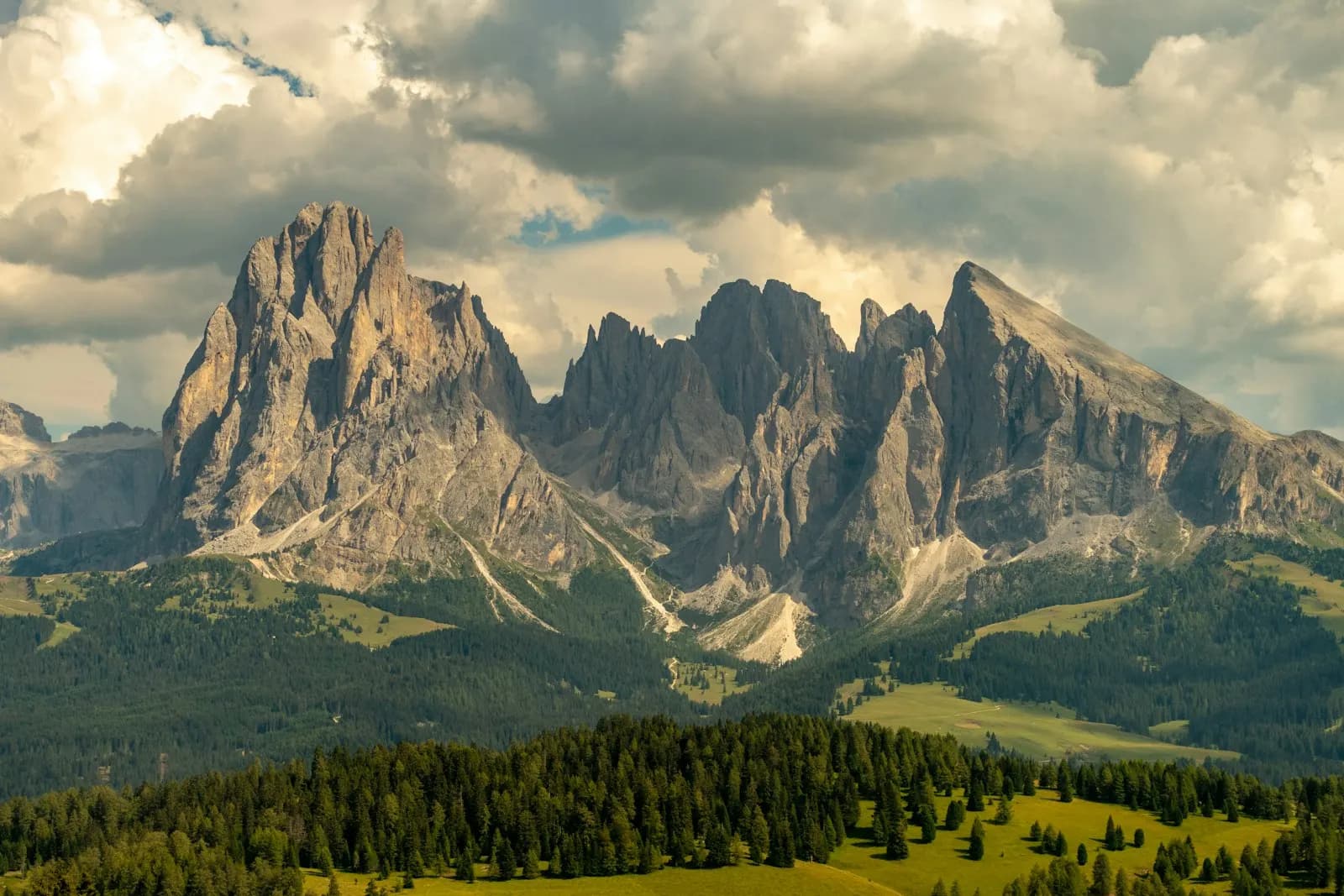
- Trip length
- 6 nights, late June
- Group
- 4 people, two comfortable with exposure
- Bases
- Ortisei 2 nights, two rifugi, Cortina area 2
- Car
- One hire car from Verona, tolls and parking on top
- Daily walking
- 9 to 17 km, 400 to 900 m of climb
- Season
- Late June, 8 to 22 degrees, snow still on north faces
The short answer
Six days is enough for two hut nights and four days from a valley base. Book rifugi in March for a summer trip; the good ones fill. Several of the famous places now restrict cars: Tre Cime charges a road toll, Braies limits access in the middle of the day and Alpe di Siusi closes to traffic between morning and late afternoon. Plan around the restrictions and the range is quiet.
What to take away
- Book rifugi in March. By June the well-placed ones are full for the season.
- Tre Cime has a road toll per car. Budget it and go early or late.
- Alpe di Siusi is closed to cars in the middle of the day. Use the cable car.
- Half board in a hut is the deal: bunk, dinner, breakfast, one price, cash often.
- Cable cars turn a 900 m climb into a 300 m walk. That is not cheating, that is the system.
The access rules are the plan
The Dolomites have absorbed a decade of growth and responded with rules. They are not obscure and they are not enforced gently, and almost nobody reads about them before arriving. Three matter for most itineraries.
Tre Cime di Lavaredo: the road up to Rifugio Auronzo is a private toll road with a per-car charge that is high enough to surprise people, and the car park at the top fills early on a good day. Lago di Braies: private cars are turned away during the middle of the day in summer and you need a shuttle, a bus or an early arrival. Alpe di Siusi: the road up is closed to non-resident traffic between morning and late afternoon, so you go by cable car from Ortisei or Siusi.
None of this ruins anything. It changes what time you leave. We hit all three, spent nothing on parking fines and never queued for more than ten minutes, purely because the constraints went into the plan before the hikes did.
- Tre Cime: per-car road toll, arrive before eight or after four.
- Braies: car access restricted in the middle of the day in summer.
- Alpe di Siusi: closed to cars 09:00 to 17:00 in season, cable car instead.
- Seceda: cable car from Ortisei via Furnes, and it is worth the money.
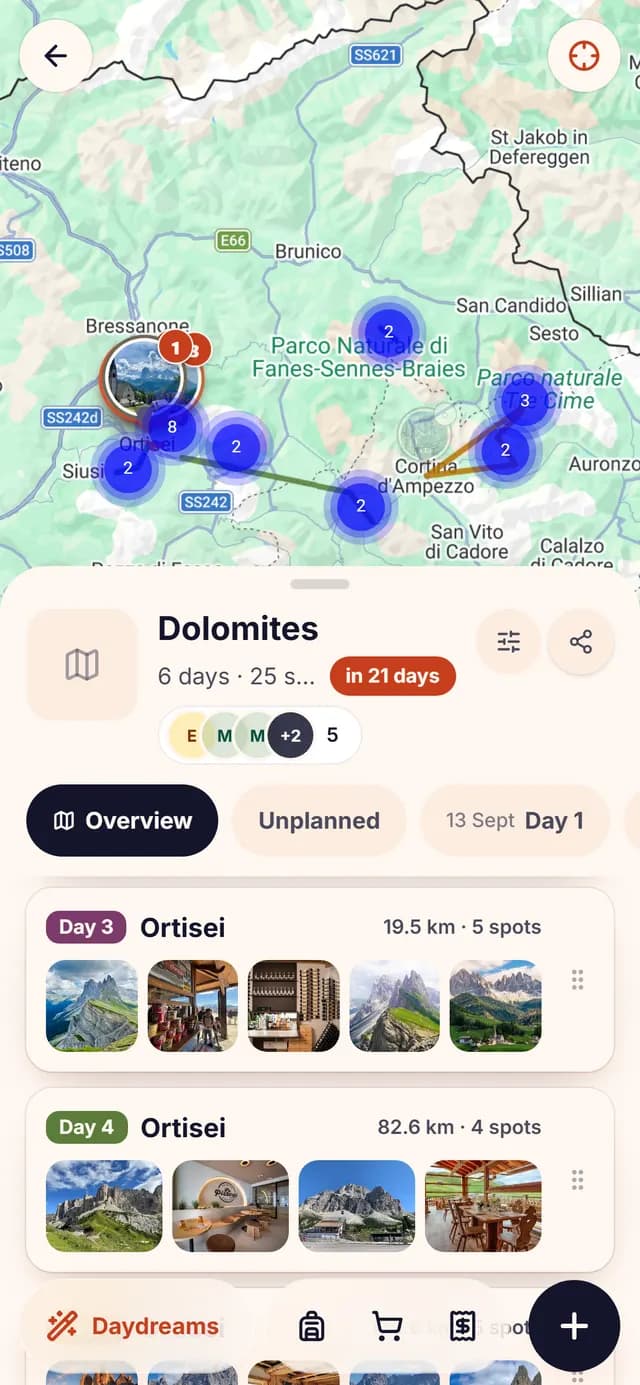
Rifugi: how half board works and when to book
A rifugio is a mountain hut, usually reachable only on foot or by cable car, offering a bunk in a shared room, dinner and breakfast for one price. That is half board, or mezza pensione, and in the Dolomites it ran 60 to 85 euros a head depending on the hut and whether you were in a room of four or a room of sixteen.
Book in March. This is the single most common Dolomites planning mistake: people book flights in April and discover in May that every well-positioned hut on their route is full for the entire summer. The famous ones, the ones with the view everybody has seen, go earliest.
What to bring: a sleeping bag liner, which most huts require, earplugs, cash because several huts still do not take cards reliably, and less than you think. What you do not need is a sleeping bag, a stove or a towel. Dinner is at a set time, everyone eats together, and lights go out early because everyone is walking in the morning.
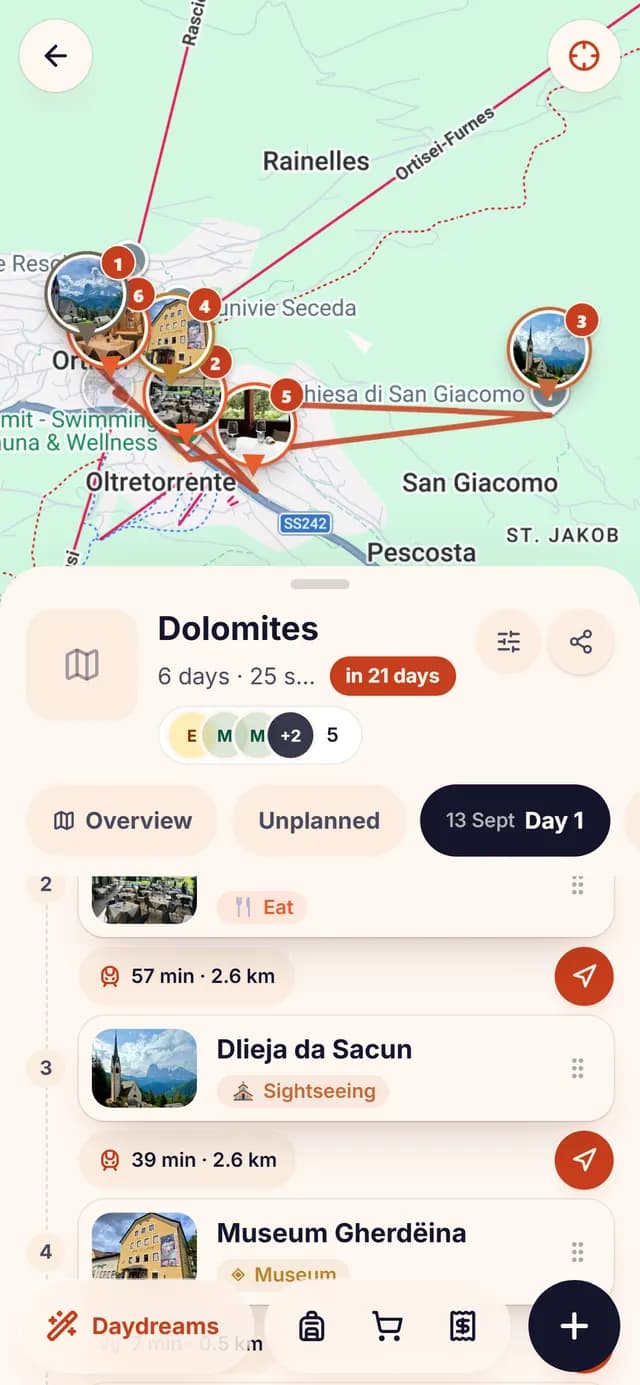
Cable cars are not cheating, they are the network
The Alps have a hundred and fifty years of infrastructure built to get people up hills, and using it is the normal way to walk here. A cable car turns a 900-metre slog up a forested valley side into a 300-metre walk along a ridge with a view, and the ridge is why you came.
Seceda is the clearest example. The cable car from Ortisei via Furnes takes you to just under 2,500 metres, and the tilted grass ridge with the sawtooth peaks behind it is a fifteen-minute walk from the top station. From there you can walk for six hours or you can walk for forty minutes. Both are legitimate.
They cost real money: a return on a two-stage lift is 30 to 45 euros a head, and several valleys sell a multi-day pass that pays for itself on the third ride. If your week involves three or more lift days, buy the pass on the first morning rather than working it out on the fourth.
Two hut nights inside a six-day trip
You do not need to do a full hut-to-hut traverse to get the experience. Two nights out is enough to understand why people do it, and it fits inside a week that otherwise runs from valley hotels with your luggage in a car.
Our version: leave the car in Ortisei, take the Seceda lift, walk the Puez-Odle plateau to a hut, sleep, walk on to a second hut, sleep, come down to a valley and take a bus back to the car. Two nights, one small bag each, and about eleven hours of walking in total.
The logistics that matter are the bag and the return. Carry only what you need for two days and leave the rest in the hotel you are coming back to, which most will hold for free. And check the bus back before you commit to a route, because valley-to-valley buses in the Dolomites are decent and infrequent, and the last one is earlier than you expect.
What six days cost, and the cash problem
The Dolomites are not cheap. A hire car from Verona with fuel and tolls, valley hotels at 90 to 140 euros a night for a double, cable cars at 30 to 45 a day, hut half board at 60 to 85, a road toll at Tre Cime, and lunches at mountain restaurants at 20 to 30 a head.
Total for six days excluding flights came to roughly 780 euros a head, of which about a third was accommodation and a quarter was lifts and tolls. That is a lot for six days and it is a landscape it is hard to be annoyed at.
The awkward part is cash. Huts, some lifts and the Tre Cime toll are frequently cash, and the machine is in the valley. We each carried 200 euros in notes for six days and used almost all of it, which meant that half the trip's spending happened in a form no bank statement would ever explain. Logging each payment as it happened was the difference between one clean settlement and four people guessing.
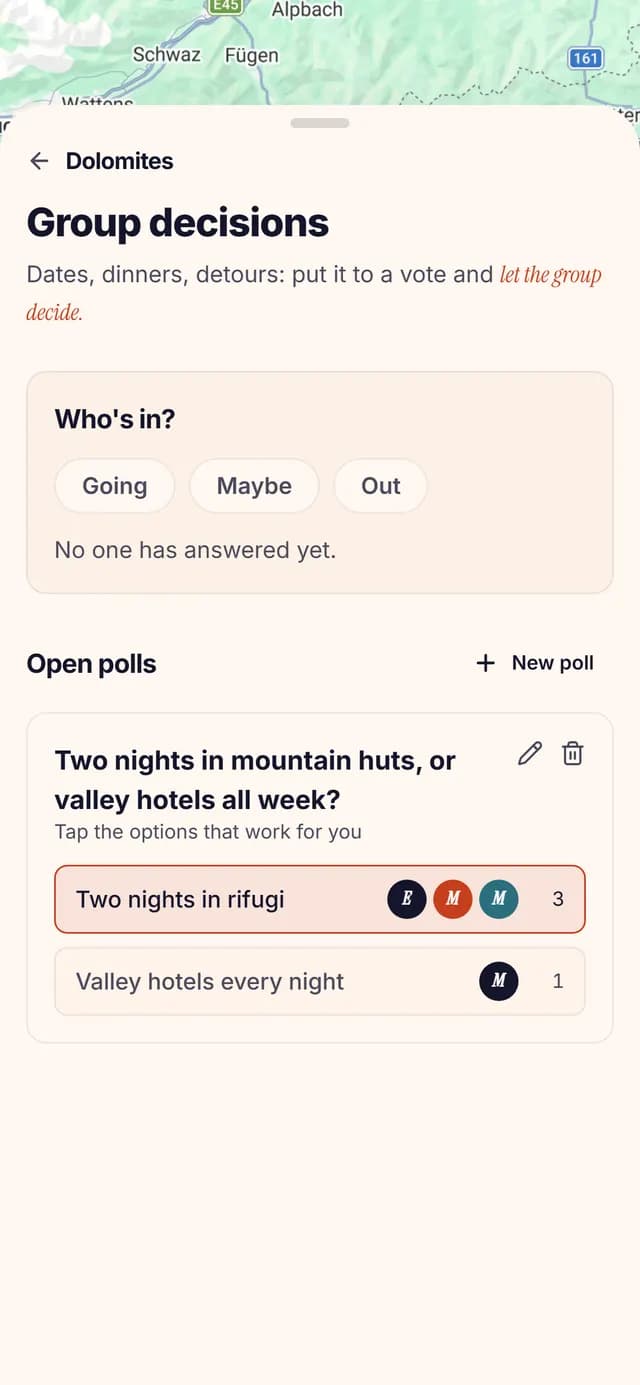
Day by day
Six days: two valleys and two huts
Ortisei as the first base, two nights on the Puez-Odle plateau, then east towards Cortina for Tre Cime and Braies. The hut nights were booked in March and everything else moved around them.
Day 1
Val Gardena and Seceda
Ortisei9.8 km with 400 m of climb
- 11:00
Drive Verona to Ortisei
Travel · 3h
Three hours, the last of it up a valley road with a gradient the hire car will comment on.
- 15:00
Seceda cable carBooked
Travel · 45m
30 to 45 euros return. Two stages via Furnes. Check the last descent time before you walk anywhere.
- 16:00
The Seceda ridge
Walk · 2h 30m
Free once you are up. The tilted grass ridge with the Odle peaks behind it is fifteen minutes from the top station.
- 19:30
Dinner in Ortisei
Food · 2h
South Tyrol is Italian and Austrian at once. The menu will have both and the dumplings will win.
Verdict. The introduction day. Seceda on the first afternoon sets the standard the rest of the week has to meet.
Days 2 to 3
Hut to hut on the Puez-Odle plateau
Two rifugi, one small bag each11 and 13 km, 700 to 900 m of climb
- 08:00
Lift up, then the plateau traverse
Walk · 6h
Leave the big bags at the hotel. High limestone plateau, marked trails, and snow patches on north faces into July.
- 16:00
Arrive at the first rifugioBooked
Hotel · 3h
60 to 85 euros half board. Booked in March. Bring a liner, earplugs and cash.
- 19:00
Dinner at the hut
Food · 2h
Set time, communal table, several courses. Lights go out early because everyone is walking at seven.
- 07:30
Second day across to the next hut
Walk · 6h
The quiet hours are before nine and after four, when the day walkers are not on the plateau.
Verdict. The heart of the trip. Two nights is enough to get it and short enough to fit.
Day 4
Down, and east to Cortina
Cortina d'Ampezzo or a village nearby7 km
- 08:30
Descend to the valley
Walk · 3h
Check the bus back to the car before you choose which valley to come down into. The last one is early.
- 13:00
Drive over the passes
Travel · 2h 30m
Gardena and Falzarego passes. Two hours of driving that people come here specifically to do on motorbikes.
- 17:00
Cortina and a proper shower
Hotel · 3h
The expensive town in the range. Villages ten minutes out cost a third less and are quieter.
Day 5
Tre Cime di Lavaredo
Cortina area, leaving early10.2 km on the loop
- 06:30
Drive the toll road to Rifugio AuronzoBooked
Travel · 1h 30m
A per-car toll, cash at the barrier. The car park fills on a good day; before eight or after four.
- 08:00
The Tre Cime loop
Walk · 4h 30m
Free. Ten kilometres around the three peaks, past Rifugio Locatelli, which is where the north faces line up.
- 12:30
Lunch at a rifugio on the loop
Food · 1h 30m
20 to 30 euros. Barley soup and strudel at 2,400 metres, and a queue at one o'clock.
- 17:00
Misurina lake on the way back
Sight · 1h
Free. Ten minutes down the toll road, and the classic reflection shot of the Sorapiss group.
Verdict. The famous one, and it earns it. The whole day is decided by what time you leave.
Day 6
Lago di Braies and out
Driving back to Verona6 km
- 06:30
Lago di Braies before the restriction
Walk · 2h 30m
Private cars are turned away in the middle of the day in summer. Arrive early or take the shuttle, and walk the loop rather than queuing for the boathouse.
- 10:00
Rowing boat on the lake
Open · 1h
Hired by the boat and the queue starts at nine. The loop path is free and better.
- 13:00
Lunch in Val Pusteria
Food · 1h 30m
Speck, dumplings and a beer in a valley village that is not on anyone's itinerary.
- 15:00
Drive back to Verona
Travel · 3h 30m
Three and a half hours. Motorway from Bolzano, and the last hour is flat and dull, which is a fair trade.
Verona and Venice Treviso are the usual arrival airports and both are around three hours from Val Gardena. Innsbruck is closer to the northern valleys if the flights work. Public transport within the Dolomites is genuinely good in summer, so if nobody wants to drive the passes, a Mobilcard and the valley buses cover most of this itinerary with more walking and less stress.
Honest comparison
A range where access rules matter more than distances
The Dolomites are unusually well documented and unusually easy to get wrong, because most of what determines your day is not the trail, it is the toll, the cable car timetable and the car ban.
Generic planners store none of that against the day you are going.
| What | Wanderlog, TripIt, Maps lists | TripSake |
|---|---|---|
| Car bans and toll roads | A place page with a rating. Nothing anywhere about a road closed to traffic from nine to five. | The note goes on the spot when you add it and travels with the plan, so "cars turned away 09:30 to 16:00" is in front of you the morning you drive there. |
| Last cable car down | Opening hours on a place page, unchecked against your plan. | A stop scheduled past closing gets flagged, which for a lift-served hike is the difference between a walk and a 900-metre descent. |
| Huts booked five months ahead | An email confirmation in one person's inbox. | Forward it and the booking sits in the trip anchored to the right night, visible to everyone from March. |
| Peaks and viewpoints with German and Italian names | Search fails when half the group types Seceda and half types Sech. | Paste the clip and the place is identified once, with both names on the pin and one set of coordinates. |
| No signal on the plateau | Offline access behind a subscription. | Plan, spots and bookings stay readable offline for free, which above 2,000 metres you will need. |
| Cash at huts, cards in the valley | A splitting app that never sees the 200 euros each of you spent in notes. | Expenses inside the trip, logged as they happen, settled once. Six days came to two transfers. |
| What it costs | A per-person subscription on top of a week that is already expensive. | Free, no premium tier. |
Nothing on this trip went wrong, and the reason is boring: the toll, the two car bans and the last lift down were all in the plan before the hikes were. That is a twenty-minute job and it is the difference between a good week here and a queue.
Questions travellers ask
Before you book
How many days do you need in the Dolomites?
Six is enough for two valleys, two hut nights and the famous loops. A week lets you add a via ferrata day or a third valley. Fewer than four days means one base and a lot of driving on pass roads.
When should I book a rifugio?
March for a summer trip. The well-positioned huts fill for the whole season by late spring. Half board runs 60 to 85 euros a head, and you need a sleeping bag liner, earplugs and cash.
How much is the Tre Cime di Lavaredo road toll?
It is charged per car at the barrier on the private road up to Rifugio Auronzo, and it is high enough that people are visibly surprised at the gate. The car park fills on good summer days, so arrive before eight or after four.
Can you drive to Lago di Braies and Alpe di Siusi?
Not in the middle of the day in summer. Braies turns private cars away during peak hours and runs shuttles, and the road up to Alpe di Siusi is closed to non-resident traffic between morning and late afternoon, so you take the cable car from Ortisei or Siusi.
Are the cable cars worth the money?
Yes, and they are how walking works here. A two-stage return is 30 to 45 euros, and a lift turns a 900-metre forest climb into a ridge walk. If your trip has three or more lift days, buy the valley pass on the first morning.
How do I plan a Dolomites trip from saved reels?
Paste the links into a TripSake trip. Peaks and huts become pins with coordinates and both their German and Italian names, hut bookings can be forwarded in as documents, and the access rules live on the spots rather than in a chat.
About the author
The TripSake travel desk plans and walks the routes we publish. This one was four people in late June, two nights in mountain huts, and a lesson about booking rifugi in March rather than in June.
Keep reading