Travel guide
A week in Lofoten: one road, four hikes and the weather deciding everything
The islands are 150 kilometres end to end on a single road. The plan is not where you go, it is which day you go there.
By TripSake travel desk · Published · Updated · 13 min read
- Trip length
- 7 nights, early September
- Group
- 4 people, mixed hiking fitness
- Bases
- Svolvaer 2 nights, Reine area 5
- Car
- Estate from Evenes, about 90 euros a day in season
- Daily walking
- 4 to 14 km, 300 to 700 m of climb
- Season
- Early September, 8 to 14 degrees, wind is the real number
The short answer
A week is right for Lofoten: two nights near Svolvaer, four in or around Reine, and a car for all of it. There is one road, the E10, and the hikes are strung along it. Plan the week as a set of options rather than a schedule, because the forecast decides the order, and book the cabins months ahead in summer.
What to take away
- A car is the trip. Buses exist, run rarely, and do not stop at trailheads.
- Plan hikes as a pool, not a schedule. The forecast picks the order each morning.
- Reinebringen is 1,566 stone steps and about two hours return. Do it on a clear day.
- Rorbu cabins book out months ahead for July. September is empty and better.
- Midnight sun late May to mid July, aurora from September. You cannot have both.
One road, and why that simplifies everything
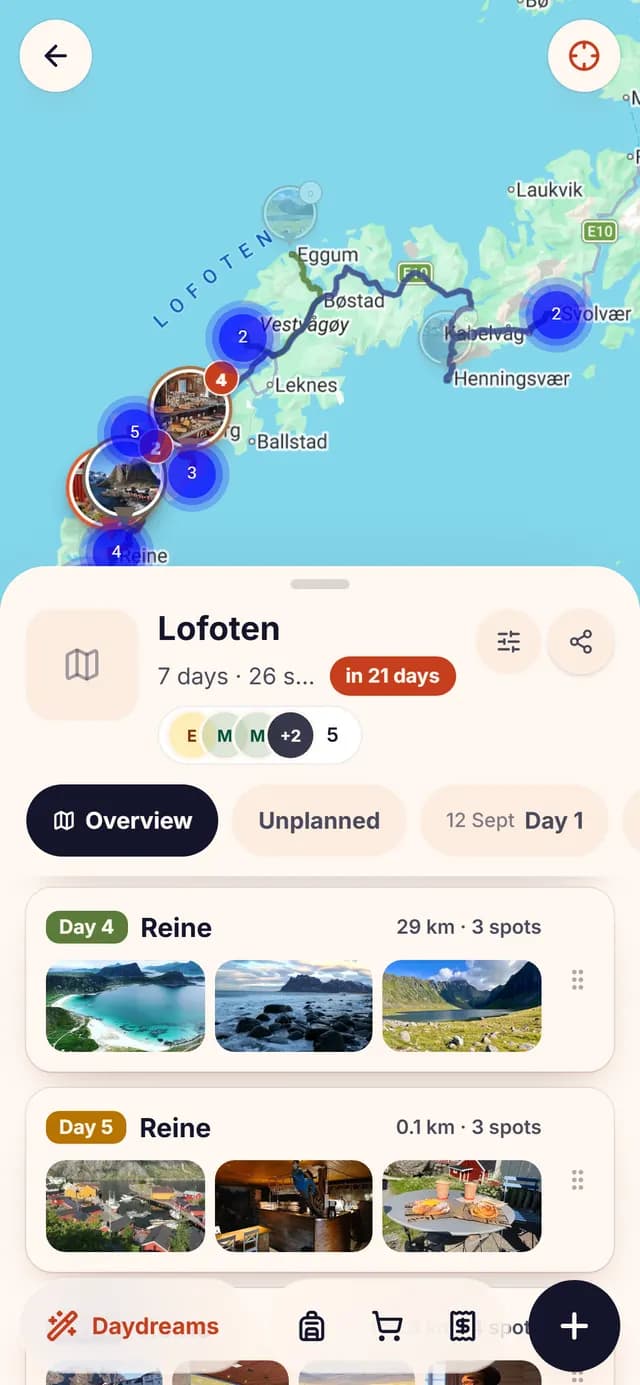
Lofoten is an archipelago strung along the E10, which runs from the mainland out to the village of A at the far end, crossing bridges and tunnels as it goes. Almost everything worth seeing is within twenty minutes of it. That makes route planning trivial and day planning the entire problem.
The distances look small and drive long. Reine to Svolvaer is about 130 kilometres and takes two hours, more if you stop, and you will stop, because the road passes about fifteen viewpoints that each deserve ten minutes. Budget double what a map says and you will be roughly right.
The practical consequence is that two bases beat five. We did two nights near Svolvaer at the eastern end and five nights around Reine at the western end, and drove out from each. Moving every night in Lofoten means spending your week packing a car in the rain.
- E10 from Fiskebol to A is the whole trip. Everything else is a spur off it.
- Two bases, not five. The road is slow and the cabins are worth settling into.
- Fly into Evenes for the cheapest connections, or Leknes and Svolvaer for the shortest drive.
- Fuel and food are expensive at the western end. Stock up in Leknes.
Plan the hikes as a pool, not a schedule
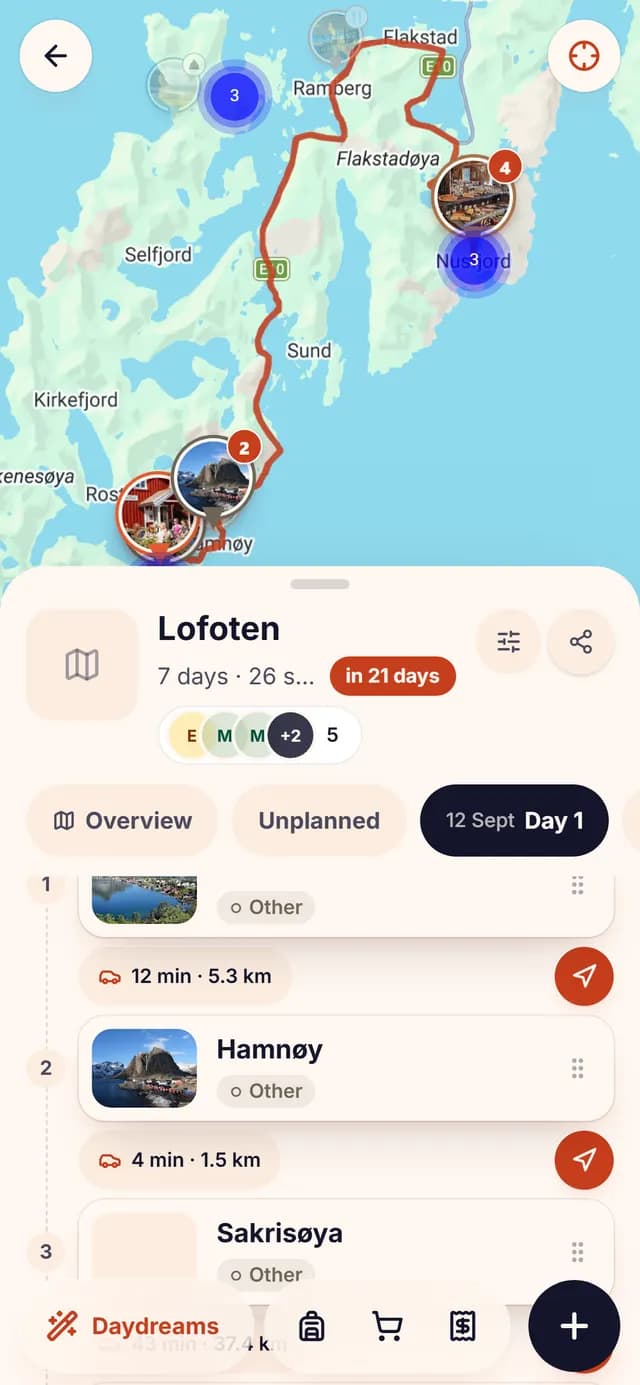
The single most useful thing we did was refuse to assign hikes to days. We put six candidates into the trip with their trailheads, their length and their climb, and then each morning picked from them based on what the forecast and the cloud base were doing.
This matters because the hikes are not interchangeable. Reinebringen is a viewpoint hike, pointless in cloud, superb on a clear afternoon. Kvalvika and Ryten give you a beach at the end, so they work in mediocre weather. The Nusfjord coastal path and the Henningsvaer harbour walk are fine in rain. Putting Reinebringen on a Tuesday because the itinerary said Tuesday is how people end up climbing 1,566 steps into a grey wall.
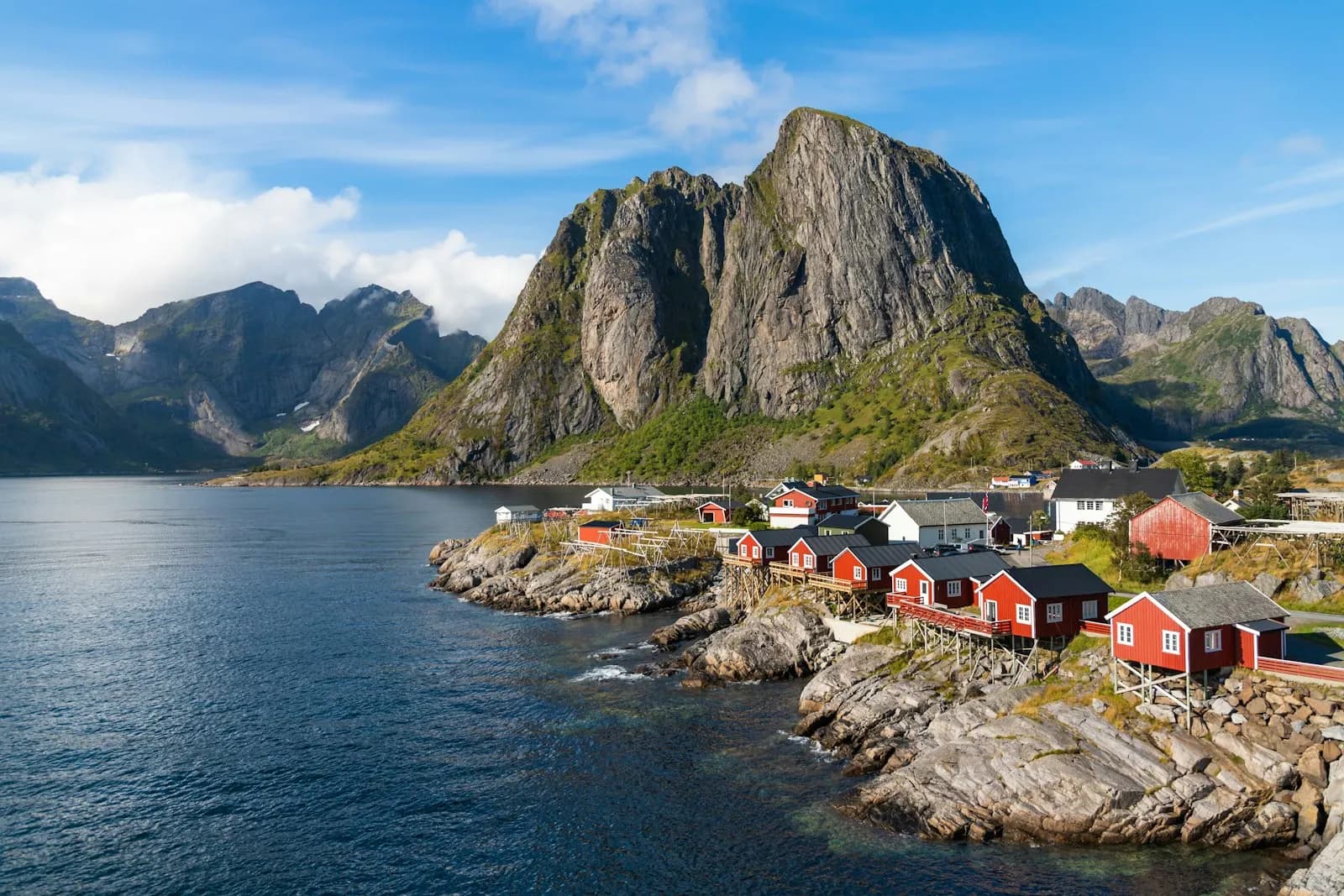
Reinebringen deserves its own paragraph. Nepalese sherpas built a stone staircase up it because the old path was eroding and dangerous. It is 1,566 steps, roughly two hours return, brutally steep and completely safe. The view over Reine at the top is the picture everyone has seen, and it is one of the few places where the photograph undersells it.
Cabins, and what the week actually costs
The classic Lofoten accommodation is a rorbu, a fishermen's cabin on stilts over the water, usually red, usually converted. They are lovely and they are not cheap: in July expect 250 to 400 euros a night for a cabin that sleeps four, booked months in advance. In September we paid closer to 180 and had the choice of most of them.
Food is the other cost. Restaurants outside Svolvaer and Reine are few and expensive, and several close entirely outside the summer season. A cabin with a kitchen is not a saving, it is a requirement. We shopped once in Leknes and cooked five nights out of seven.
Total for a week, excluding flights, came to roughly 950 euros a head including the car, the cabins, food and one restaurant meal. That is a lot for northern Europe and about half what the same week costs in July.
Midnight sun or aurora: pick one
From late May to mid July the sun does not set. That means hiking at midnight, no headtorch, and a strange elastic sense of time that is genuinely one of the great travel experiences. It also means no northern lights, at all, because there is no dark.
From September the nights come back and the aurora becomes possible. Early September gives you both a usable amount of daylight for hiking and real darkness after ten. That is why we went then, and we got two clear nights out of seven, which locals told us was about normal.
What nobody mentions is the wind. Lofoten temperatures are mild for the latitude thanks to the Gulf Stream, but the wind on an exposed ridge changes the number by ten degrees. The forecast that matters is not the temperature, it is the wind speed and the cloud base.
Four people, one car and a Norwegian card machine
Norway is the easiest country in the world to split costs in and the hardest to feel good about spending in. Everything takes a card, including the toilet at the trailhead and the honesty box at a car park. There is essentially no cash economy.
The costs that scale with the group are the car, the cabins and the fuel, which are the big ones, and the ones that do not are food and the occasional ticket. The classic failure mode is one person putting both cabins on their card in February and everyone forgetting until the last night.
We put the two cabin bookings into the trip when we booked them, months ahead, so the amounts sat there visible to everyone for the whole run-up. The rest went in as it happened. Settling was one transfer each and took about four minutes.
Day by day
Seven days along the E10
Two bases and a pool of hikes rather than a fixed order. What follows is how our week actually resolved; yours will resolve differently and that is the point.
Day 1
Arrival and the drive in
Svolvaer4 km
- 12:00
Pick up the car at EvenesBooked
Travel · 1h
Book months ahead in summer. Cars run out on Lofoten in a way they do not elsewhere.
- 13:30
Drive the E10 west
Travel · 3h
Three hours with stops. The bridges onto the islands are the moment the trip starts.
- 17:30
Svolvaer harbour
Walk · 1h 30m
The largest town on the islands, which means it has a supermarket and three restaurants.
- 19:30
Dinner and the shop
Food · 2h
Eat out here. West of Leknes the options thin out fast and close early.
Verdict. The drive from Evenes is three hours and is itself one of the better roads in Europe.
Day 2
Henningsvaer and the eastern end
Svolvaer9.4 km
- 09:30
Henningsvaer
Walk · 3h
A fishing village on rocks connected by bridges, with the football pitch everybody photographs from the hill above it. Free, and better in bad light.
- 13:00
Lunch at the harbour
Food · 1h 30m
Fish soup, which in Lofoten is a main course and not a starter.
- 15:00
Festvagtinden or the Djevelporten
Walk · 3h
Short steep hikes above Svolvaer. The Devil's Gate is a boulder wedged between two rock faces and the queue for the photo is real.
- 21:00
Aurora watch, if the sky is clear
Open · 2h
From September. Get away from the harbour lights; ten minutes out of town is enough.
Verdict. A weather-proof day. All of it works in rain, which is why it went first.
Days 3 to 4
Move west, Nusfjord and Kvalvika
A rorbu near Reine or Hamnoy11 to 14 km
- 09:00
Drive Svolvaer to Reine
Travel · 2h 30m
Two hours of driving and four hours of stopping. Leave early and accept it will take all morning.
- 11:00
Nusfjord
Sight · 2h
A preserved fishing village in a narrow inlet. There is a small entry fee in season and it is one of the few sheltered walks on the islands.
- 10:00
Kvalvika beach and Ryten
Walk · 5h
About an hour over a pass to an empty beach, then another 45 minutes up Ryten for the cliff-edge view down onto it. The best half day in Lofoten.
- 18:00
Cook at the cabin
Hotel · 3h
This is what the kitchen is for. Restaurants at this end are few, expensive, and shut by nine.
Verdict. The move west is the day the islands get serious. Everything after this is within half an hour.
Day 5
Reinebringen, on the clear day
Reine5.6 km with 450 m of climb
- 09:00
Reinebringen
Walk · 2h 30m
Free. A Sherpa-built stone staircase, 1,566 steps, about two hours return. Steep, safe, and the view is the one on every poster.
- 13:00
Reine and Hamnoy
Walk · 2h
The red cabins on the bridge at Hamnoy are the single most photographed view in northern Norway. Park properly; the verges are private and enforced.
- 16:00
A to Tind coastal road
Travel · 2h
The end of the E10. A is a village with a name of one letter and a stockfish museum that is better than it sounds.
Verdict. Wait for the weather. This hike in cloud is 1,566 steps to look at fog.
Days 6 to 7
Beaches, Fredvang and the way back
Reine, then the drive out6 to 12 km
- 10:00
Haukland and Uttakleiv
Open · 4h
White sand, turquoise water, eight degrees. There is a coastal path between the two that takes about forty minutes.
- 10:00
Fredvang bridges viewpoint
Sight · 1h
Free. The two arched bridges from the hill above, which is the other photograph everyone has seen.
- 14:00
Vikten glassblowing or Eggum
Sight · 2h 30m
Rainy-day options that are genuinely worth a slot rather than a consolation.
- 12:00
Drive back to Evenes
Travel · 4h
Four hours with the stops you will make anyway. Do not book a flight before mid afternoon.
Evenes is the practical airport and it is a three to four hour drive from Reine. Leknes and Svolvaer have small airports with connections through Bodo, which cost more and save two hours of driving. If you are continuing south, the ferry from Moskenes to Bodo takes three to four hours and takes cars, and in summer it needs booking.
Honest comparison
Planning a week where the weather rewrites the order daily
Lofoten is the clearest case we have found for planning options rather than schedules. The route is trivial and the sequencing is everything, and the sequencing is decided by a forecast you cannot see until you are there.
Most planners are built to lock a plan. This is a trip where the plan needs to be re-cut every morning without losing anything.
| What | Wanderlog, TripIt, Maps lists | TripSake |
|---|---|---|
| Hikes as a pool of options | A fixed day-by-day list. Moving Tuesday to Thursday means retyping both days. | Spots sit in the trip unassigned until you place them, and moving one to another day is a drag rather than a rewrite. On a week like this we re-cut the plan four times. |
| Clips of a beach with no name | Search needs "Kvalvika". A drone shot captioned "Norway core" does not have it. | Paste the link and the place comes back pinned with photos and the trailhead location, which is what you actually need to drive to. |
| No signal in the fjords | Offline access sits behind a subscription in most planners. | Plan, spots, addresses and bookings work offline for free. Between Nusfjord and Reine there are long stretches with nothing. |
| Cabins booked six months out | A confirmation email in one person's inbox that nobody else can see. | Forward the confirmation and the booking sits in the trip as a document, anchored to the right night, visible to everyone. |
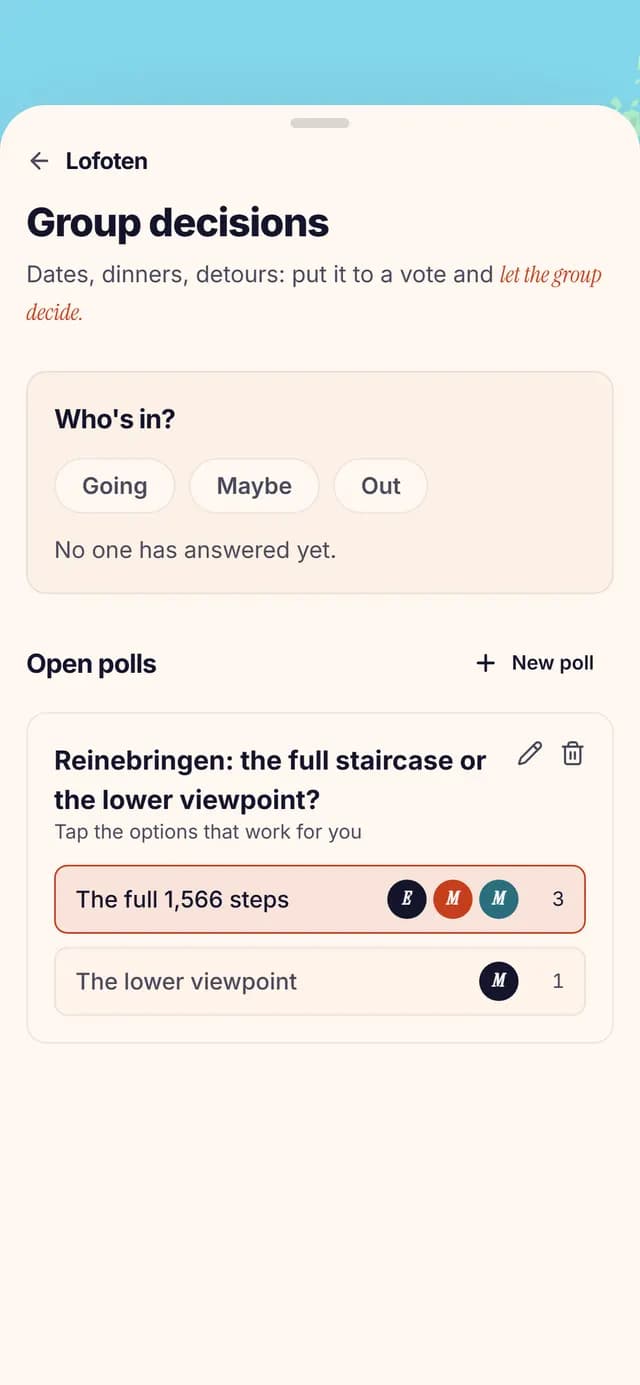
| Four people, six hikes, two fitness levels | A group chat argument that resets every evening. | Yes or no per spot plus a poll. Ours was the full Reinebringen against the lower viewpoint, and the steps won 3 to 1. |
| One card for two cabins | A splitting app opened at the end of the week, missing the deposits paid in March. | Expenses live in the trip from the moment you book, so a deposit paid six months early is visible to everyone six months early. |
| What it costs | A per-person subscription, in a group where exactly one person will buy it. | Free, with no premium tier. |
Lofoten is a week where the value is in re-planning cheaply. We rearranged the hikes four times in seven days, each time in under a minute, and got the two clear afternoons onto the two hikes that needed them.
Questions travellers ask
Before you book
How many days do you need in Lofoten?
Seven is comfortable: two nights at the eastern end near Svolvaer and five around Reine. Five days works if the weather cooperates, which is not something to count on. Fewer than four and one bad front eats the trip.
Do I need a car in Lofoten?
Effectively yes. There is a bus along the E10 but it runs a handful of times a day and does not serve trailheads. Cars sell out in summer, so book with the flights, not after them.
How hard is the Reinebringen hike?
Steep but straightforward: 1,566 Sherpa-built stone steps, about 450 metres of climb and roughly two hours return. It is safe in dry conditions and slippery in rain, and the view is the reason most people come.
When can you see the northern lights in Lofoten?
From about September to early April, when the nights are dark again. Between late May and mid July there is midnight sun and no aurora at all. Early September gives you both usable hiking daylight and real darkness after ten.
What does a week in Lofoten cost?
Around 950 euros a head in September excluding flights, covering the car, cabins, food and one restaurant meal. July is roughly double, mostly through accommodation, and needs booking months ahead.
How do I plan a Lofoten trip from saved reels?
Paste the links into a TripSake trip. Beaches and viewpoints from the clips become pins with real coordinates, hikes can sit unassigned until the forecast decides, and moving a day is a drag rather than a rewrite.
About the author
The TripSake travel desk plans and walks the routes we publish. This one was four people in early September, one rental car, and three days of horizontal rain that turned out to be the best part.
Keep reading