Travel guide
Six days in Seoul: palaces, Seongsu and the neighbourhood order that matters
Seoul is not a list of sights, it is a set of neighbourhoods with opening times. Get the order wrong and you cross the river four times for no reason.
By TripSake travel desk · Published · Updated · 13 min read
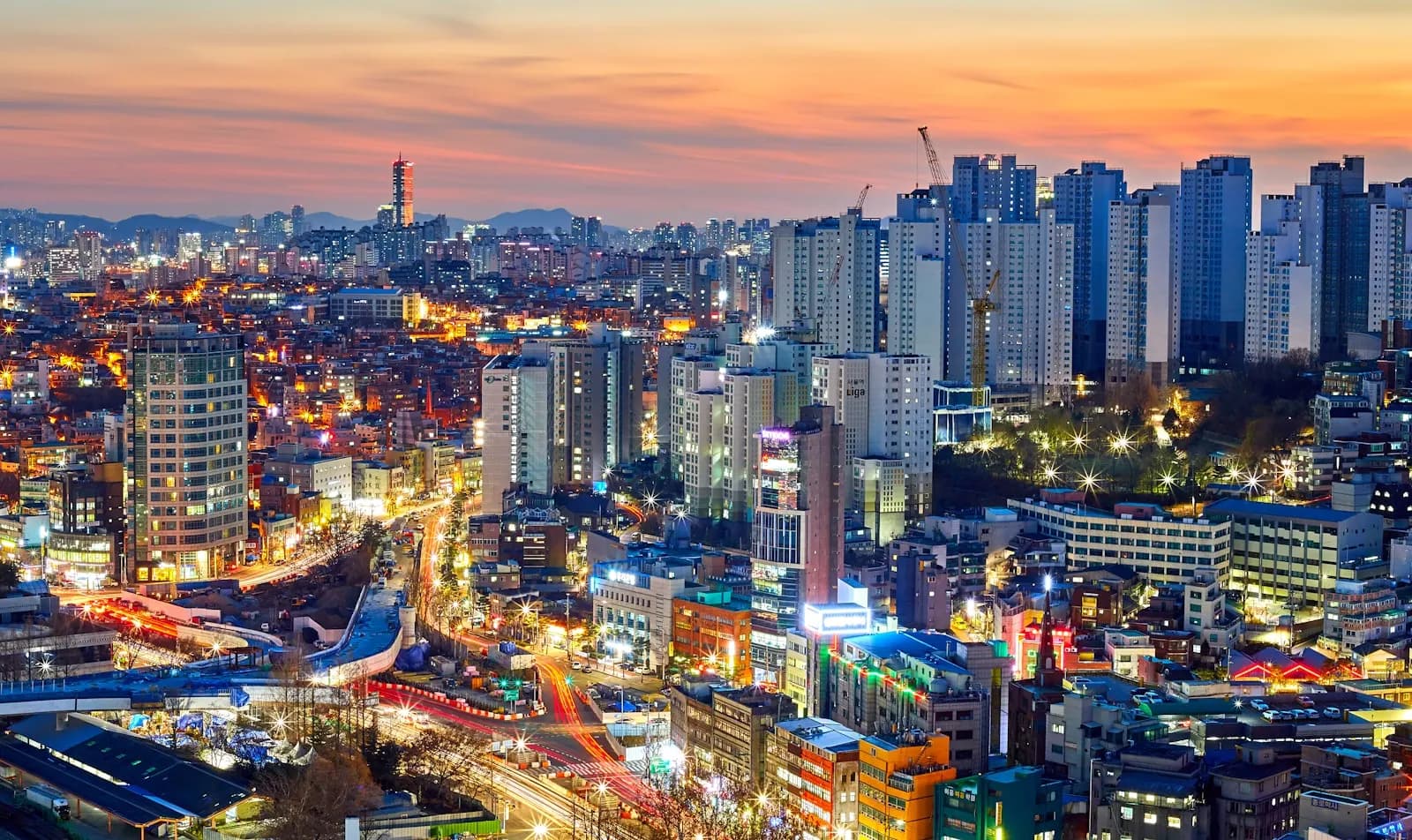
- Trip length
- 6 nights, late October
- Group
- 4 people, two of them very online
- Base
- One flat in Euljiro for the whole trip
- Transport
- T-money card, about 1,400 won a ride
- Daily walking
- 11 to 19 km
- Season
- Late October, 12 to 20 degrees, dry
The short answer
Six days in Seoul works as one neighbourhood a day plus one mountain. Do the palaces early in the morning, rent a hanbok if you want Gyeongbokgung free, book Changdeokgung's Secret Garden ahead because it is timed and capped, and keep the north and south of the river on separate days. A T-money card and the subway cover everything else.
What to take away
- One neighbourhood a day. Crossing the Han more than once a day is wasted time.
- A hanbok rental gets you into Gyeongbokgung free, and the rental costs more than the ticket.
- The Secret Garden at Changdeokgung is timed, capped and worth booking a week out.
- Bukchon is a residential village with quiet hours. Go before 10:00 and keep it down.
- Bukhansan is a metro ride from the city and the best half day in Seoul.
Move the neighbourhood, not the group
The mistake people make in Seoul is planning by sight rather than by district. The city is huge and the metro is excellent, which combine into a trap: everything is reachable, so a day ends up as four things scattered across forty kilometres and two river crossings.
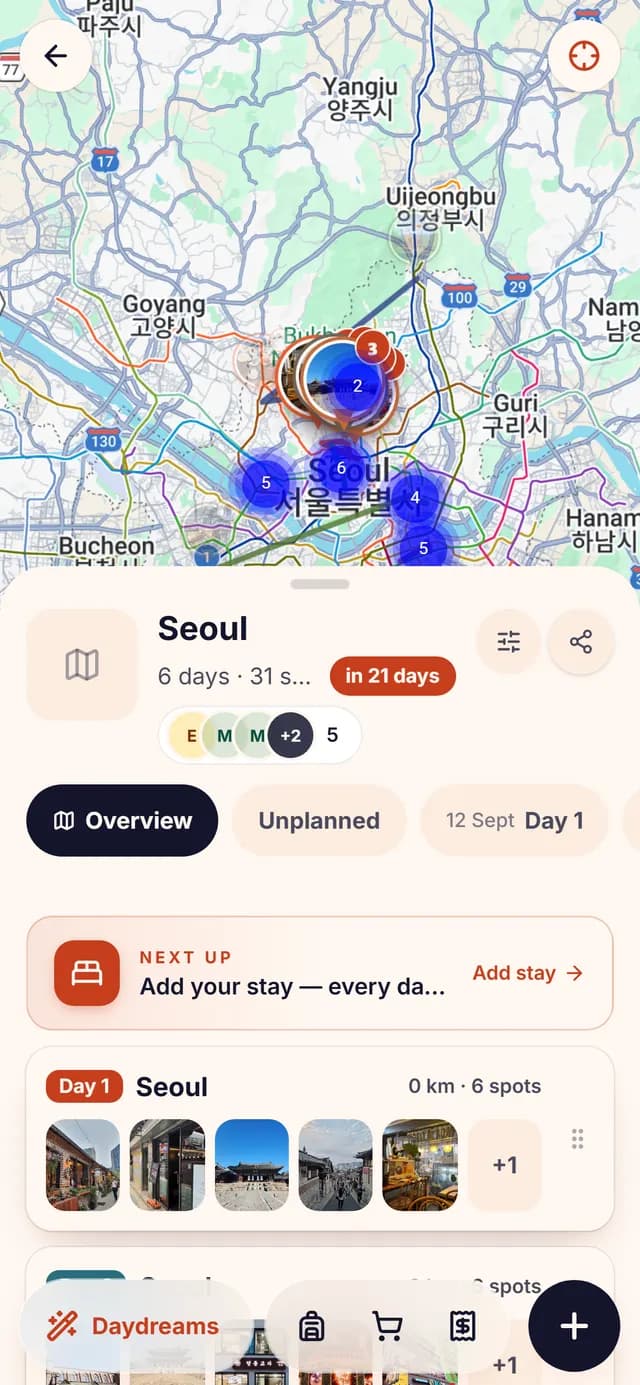
A better shape is one district a day, each with a morning anchor and an evening that stays put. Gyeongbokgung and Bukchon in the north. Seongsu and Seoul Forest on the east bank. Hongdae and Yeonnam in the west. Gangnam and the COEX library south of the river, which is a day, not an evening tacked onto a day in Jongno.
We kept one flat in Euljiro for six nights and never regretted it. It is central, it has the best old-building drinking streets in the city, and it is within two stops of most of the anchors.
- Jongno and Bukchon: palaces, hanok streets, Ikseon-dong for dinner.
- Seongsu: the converted factories, coffee, and Seoul Forest next door.
- Hongdae and Yeonnam: student energy, Gyeongui line park, late food.
- Gangnam and COEX: the library, the shops, and a different city entirely.
Palaces: which one, and the hanbok thing
There are five palaces and you do not need five. Gyeongbokgung is the biggest and the one with the changing of the guard. Changdeokgung is the more beautiful one, because it was built into the landscape rather than on a grid, and its Secret Garden is the reason to go.
The Secret Garden is a separate timed ticket with a capped group size, guided, and it sells out in autumn. Book it about a week ahead for an English slot. The main palace grounds you can walk in on the day.
The hanbok rule is real: wear traditional dress and entry to the palaces is free. A rental for a few hours costs several times more than the ticket, so it is not a saving, it is a decision about what kind of morning you want. Two of us did it, two did not, and the palace was more fun for the two who did.
Bukchon has hours now, and they are enforced
Bukchon Hanok Village is a residential neighbourhood of traditional houses on a hill between two palaces. It became one of the most photographed streets in Asia, the residents got tired of it, and the district responded with restricted visiting hours on the busiest lanes, signage, and staff who will tell you to be quiet.
None of this is a reason not to go. It is a reason to go early, walk rather than pose, and treat the alleys as somebody's street, which they are. Before ten in the morning it is quiet, the light is better, and you can hear the neighbourhood.
Ikseon-dong, twenty minutes downhill, is the version of this that is actually built for visitors: hanok houses converted into cafes, bars and small restaurants in a grid of lanes too narrow for cars. It is where we ate twice.
Seongsu, and the coffee economy
Seongsu is a former shoe-manufacturing district on the east bank that has become the place people fly in to photograph. Brick warehouses turned into cafes and flagship stores, a lot of concrete, and a density of good coffee that is genuinely hard to match anywhere.
A word on the queues. The famous places run waiting lists through a kiosk app at the door, in Korean, and the wait on a weekend afternoon can be an hour. Weekday mornings the same cafes are half empty. If your plan has a specific cafe in it on a Saturday at three, your plan has a queue in it.
Seoul Forest sits next door and is the correct antidote: a large park with deer, a lake and enough space to recover before the next thing. We did Seongsu on a Tuesday and it was the best day of the trip.
What six days cost, and the settling
Seoul is not cheap in the way Southeast Asia is cheap, and it is much better value than Tokyo for food. A proper Korean barbecue for four ran about 100,000 won including drinks. Gimbap and a soup for lunch, 9,000. A speciality coffee, 6,000 to 8,000. Palace entry 3,000. Subway rides about 1,400.
The costs that surprised us were the taxis after midnight, when the surcharge applies and the metro has stopped, and the queue-jumping habit of paying for a second dessert while waiting for the first cafe. Neither is large. Both happen four times a day.
Card acceptance is close to universal, which means the splitting problem in Seoul is not lost cash, it is four people each tapping a different card at a different counter for a shared meal. Logging as it happened cost ten seconds a time and turned twelve days of small transactions into one transfer each.
Day by day
Six days, one neighbourhood at a time
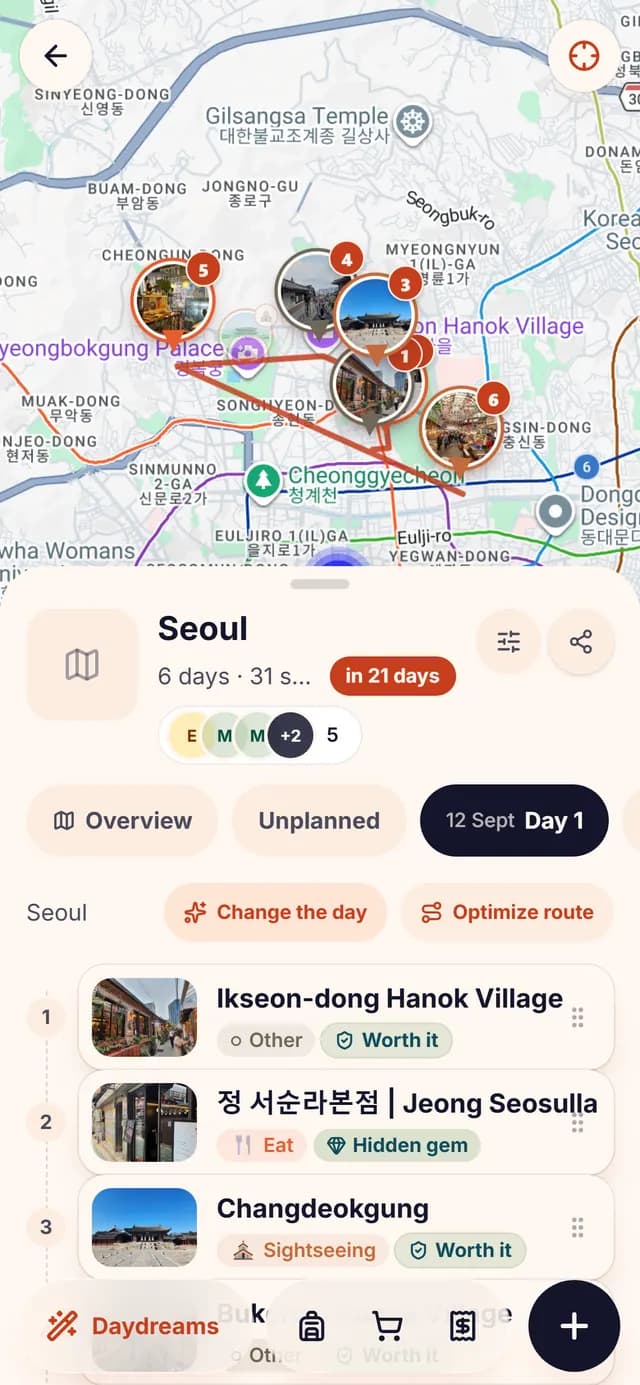
One base in Euljiro, one district a day, and the mountain on the day with the best forecast. The Secret Garden slot was booked before we flew and everything else moved around it.
Day 1
Jongno: palaces and hanok
Euljiro, ten minutes by metro13.4 km on foot
- 08:30
Bukchon Hanok Village
Walk · 1h 30m
Free. Go before the restricted lanes get busy and keep the volume down. People live here.
- 10:30
Gyeongbokgung Palace
Sight · 2h
3,000 won, or free in hanbok. The guard-changing ceremony runs a couple of times a day at the main gate.
- 13:00
Tosokchon or a Jongno lunch
Food · 1h 30m
Samgyetang, the whole chicken stuffed with rice and ginseng. Expect a queue at the famous one.
- 15:00
Changdeokgung and the Secret GardenBooked
Sight · 2h 30m
Timed, capped and guided. Book the English slot around a week ahead in autumn.
- 18:30
Ikseon-dong for dinner
Food · 3h
Hanok alleys converted into small restaurants and bars, twenty minutes downhill from the palace.
Verdict. The classic day, and it only works early. By noon Gyeongbokgung is a school-trip car park.
Day 2
Seongsu and Seoul Forest
East bank, Seongsu station11.8 km
- 10:00
Seongsu-dong cafes and flagships
Coffee · 3h
Converted shoe factories. The famous ones run a waiting list at the door; weekday mornings there is no list.
- 13:30
Lunch in a Seongsu backstreet
Food · 1h 30m
The lanes behind the main strip still have workers' restaurants at a third of the price.
- 15:30
Seoul Forest
Walk · 2h
Free. Deer, a lake and enough space to sit down after a morning of concrete.
- 18:00
Han River at Ttukseom
Open · 2h
Free. Convenience-store ramen at a riverside table is a genuine Seoul institution, not a bit.
Verdict. Do it on a weekday. The same district on a Saturday is a queue with buildings around it.
Day 3
Bukhansan
North of the city, on the metro9 km with 700 m of climb
- 08:00
Metro to Bukhansanseong
Travel · 1h
Around an hour from the centre. There is a national park with granite peaks at the end of a subway line, which is not normal.
- 09:00
Baegundae or the fortress wall trail
Walk · 5h
Free. Baegundae is the summit and involves cables near the top. The wall trail is gentler and still has the views.
- 15:00
Makgeolli and pajeon at the trailhead
Food · 1h 30m
Rice wine and a savoury pancake after a hike is the correct order of operations in Korea.
- 19:00
Korean barbecue back in town
Food · 2h 30m
About 100,000 won for four with drinks. The staff cut the meat, which is not a service you should decline.
Verdict. The best half day in Seoul, and it is inside the city limits.
Day 4
Hongdae, Yeonnam and the markets
West of the centre14.2 km
- 11:00
Gwangjang Market
Food · 2h
Bindaetteok and mayak gimbap at a counter with plastic stools. Cash is still faster here than card.
- 14:00
Hongdae streets
Walk · 2h 30m
Student district, buskers, and the best shopping for people who do not like shopping.
- 17:00
Gyeongui Line Forest Park, Yeonnam
Walk · 2h
Free. A disused railway turned into a linear park that the neighbourhood treats as its garden.
- 20:00
Yeonnam dinner and a second bar
Evening · 3h
Quieter and better than Hongdae proper for eating, five minutes away from it.
Day 5
South of the river
Gangnam and COEX10.6 km
- 10:30
Starfield Library at COEX
Sight · 1h 30m
Free. Thirteen-metre shelves in a shopping mall atrium. It is a photograph, and it is also a genuinely nice place to sit.
- 13:00
Lunch in Apgujeong
Food · 1h 30m
Where the price of a coffee tells you which side of the river you are on.
- 15:00
Bongeunsa temple
Sight · 1h 30m
Free. A working temple opposite the convention centre, which is the whole of Seoul in one view.
- 18:00
Banpo Bridge and the river park
Open · 2h 30m
The bridge fountain runs on a schedule in the warmer months. Check it before you go rather than after.
Verdict. A whole day or none. Bolting Gangnam onto a Jongno evening is how you spend an hour underground.
Day 6
Euljiro, and whatever you missed
Walking distance from the flat8 km
- 11:00
Euljiro printing district cafes
Coffee · 2h
Coffee bars hidden on the third floor of machine-shop buildings, reached by a lift you would not otherwise enter.
- 14:00
Namsan and the city wall path
Walk · 3h
Walk up rather than taking the cable car. The wall trail from Dongdaemun is the quiet way and takes about an hour.
- 19:00
Euljiro nogari alley
Evening · 3h
Dried pollock and beer at plastic tables in the street. In autumn this is the best evening in the city.
Incheon is about an hour by the airport express from Seoul Station, and the city-airport terminal there lets you check bags in early. Gimpo is much closer and handles a lot of the regional flights. If you are continuing to Busan, the KTX takes under three hours and is a better use of a day than a domestic flight.
Honest comparison
Six people, four cafes and a queue app in Korean
Seoul is the trip where saved videos outnumber days by twenty to one, and where almost none of them name the place.
The second problem is the ordering. A city with this good a metro tempts you into a plan that spends two hours a day underground.
| What | Wanderlog, TripIt, Maps lists | TripSake |
|---|---|---|
| Cafes with no legible name | Search needs the Korean name, or a transliteration that three people spell differently. | Paste the clip. The place shown or mentioned comes back as a pin with photos, the Korean name, the rating and the hours, so the address works in a taxi. |
| A day that crosses the river twice | A list of places in the order you saved them, with no idea that two are 45 minutes apart. | Stops sequenced by real travel time, so a day stays in one district and the plan tells you when it has not. |
| Timed tickets like the Secret Garden | A note in a description field that nothing checks. | The booking anchors its day, and the rest of the day is planned around the slot rather than through it. |
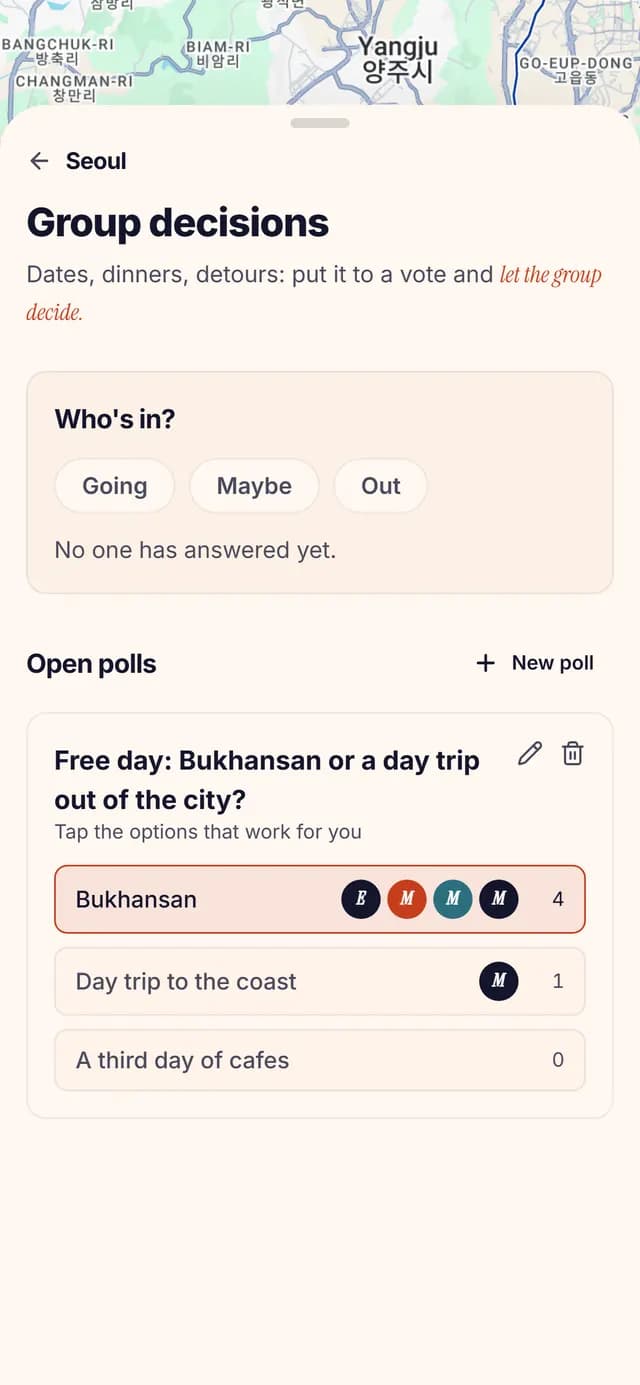
| Four people and forty cafes | Shared editing, so the list grows and never shrinks. | Yes or no per spot. Forty became eleven in one evening, and nobody had to defend a rejection out loud. |
| The friend without an account | Sign up before you can add a pin. | One invite link and guests can vote, add and read the plan. |
| Four cards at four counters | A separate splitting app, opened on day three. | Expenses in the trip with receipt scanning, split as you go, settled once. |
| What it costs | A per-person subscription in a group where only one person will pay it. | Free, no premium tier, no asymmetry in the group. |
Seoul does not need a planner to tell you what to see; the city is well documented. It needs one to turn eighty saved clips into eleven real addresses and to stop a day from crossing the Han three times.
Questions travellers ask
Before you book
How many days do you need in Seoul?
Five to six for a first visit: one day for the palaces and Bukchon, one for Seongsu, one for Hongdae and the markets, one south of the river and one for Bukhansan. A week lets you add Busan or the DMZ without cutting anything.
Is the hanbok rental worth it for free palace entry?
Not as a saving. Palace entry is 3,000 won and a hanbok rental costs several times that. It is worth it if you want that kind of morning, and the palaces are noticeably more fun in one.
Do I need to book Changdeokgung Secret Garden in advance?
Yes in spring and autumn. The tour is timed, guided and capped, and English slots go about a week ahead in October. The main palace grounds need no booking.
Is Bukchon Hanok Village still worth visiting?
Yes, early. It is a residential neighbourhood with restricted visiting hours on the busiest lanes and staff enforcing quiet. Go before ten, walk rather than pose, and treat it as somebody's street. Ikseon-dong is the version built for visitors.
What is the best area to stay in Seoul?
Euljiro and Jongno for central and walkable with good bars, Hongdae for nightlife and a younger crowd, Seongsu for cafes and quiet. We used one flat in Euljiro for six nights and never wanted to move.
How do I turn saved Seoul TikToks into an itinerary?
Paste them into a TripSake trip. Places shown or mentioned become pins with photos, the Korean name, ratings and opening hours, and the plan sequences them by real travel time so a day stays in one part of the city.
About the author
The TripSake travel desk plans and walks the routes we publish. This one was four people in late October, when the ginkgo trees turn and the city is at its best.
Keep reading